Ch. 3 - Describing, Exploring, and Comparing Data
Triola - Elementary Statistics 14th Edition
Triola14th EditionElementary StatisticsISBN: 9780137366446Not the one you use?Change textbook
Chapter 3, Problem 3.1.2

What’s Wrong? Education Week magazine published a list consisting of the mean teacher salary in each of the 50 states for a recent year. If we add the 50 means and then divide by 50, we get \$56,479. Is the value of \$56,479 the mean teacher salary for the population of all teachers in the 50 United States? Why or why not?

Verified step by step guidance
1
Step 1: Understand the concept of a mean. The mean is calculated by summing all values in a dataset and dividing by the number of values. In this case, the dataset consists of the mean teacher salaries for each state.
Step 2: Recognize the distinction between the mean of means and the overall population mean. The value \$56,479 is the mean of the state-level means, not the mean of all individual teacher salaries across the United States.
Step 3: Explain why the mean of means may not represent the population mean. Each state has a different number of teachers, so the state-level means are weighted differently in the overall population mean. States with more teachers contribute more to the population mean than states with fewer teachers.
Step 4: To calculate the true population mean, you would need to sum the salaries of all individual teachers across the 50 states and divide by the total number of teachers. This approach accounts for the varying number of teachers in each state.
Step 5: Conclude that \$56,479 is not the mean teacher salary for the population of all teachers in the United States. It is simply the mean of the state-level means, which does not account for the differing teacher populations in each state.

Verified video answer for a similar problem:

This video solution was recommended by our tutors as helpful for the problem above.
Video duration:
3m
Was this helpful?

Key Concepts

Here are the essential concepts you must grasp in order to answer the question correctly.

Mean vs. Weighted Mean

The mean is calculated by summing all values and dividing by the number of values. However, in this context, the mean teacher salary for each state may not represent the overall mean for all teachers if the number of teachers varies significantly between states. A weighted mean, which accounts for the number of teachers in each state, would provide a more accurate representation of the average salary across the entire population.
Recommended video:
Guided course
04:52
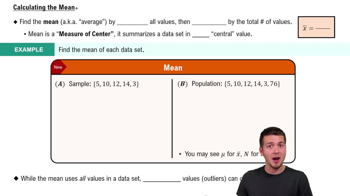
Calculating the Mean

Population vs. Sample

In statistics, a population includes all members of a defined group, while a sample is a subset of that population. The mean salary calculated from the state means does not consider the distribution of teachers within each state, making it a sample mean rather than a true population mean. This distinction is crucial for understanding the limitations of the reported average.
Recommended video:
05:11
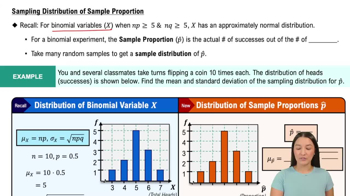
Sampling Distribution of Sample Proportion

Variability and Distribution

Variability refers to how much the data points differ from each other and from the mean. In this case, teacher salaries can vary widely between states due to factors like cost of living and funding. Understanding the distribution of salaries is essential, as it affects the interpretation of the mean and whether it accurately reflects the salary landscape for all teachers.
Recommended video:
Guided course
07:09
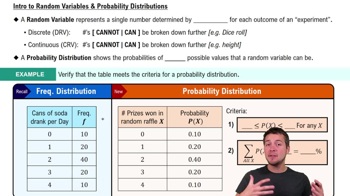
Intro to Random Variables & Probability Distributions
Related Practice
Textbook Question

Percentiles. In Exercises 17–20, use the following radiation levels (in W/kg) for 50 different cell phones. Find the percentile corresponding to the given radiation level.


1.47 W/kg

144
views

Textbook Question

Boxplots from Large Data Sets in Appendix B. In Exercises 33–36, use the given data sets in Appendix B. Use the boxplots to compare the two data sets.


Pulse Rates Use the same scale to construct boxplots for the pulse rates of males and females from Data Set 1 “Body Data” in Appendix B.

172
views
Textbook Question

Percentiles. In Exercises 17–20, use the following radiation levels (in W/kg) for 50 different cell phones. Find the percentile corresponding to the given radiation level.


0.48 W/kg

222
views
Textbook Question

Geometric Mean The geometric mean is often used in business and economics for finding average rates of change, average rates of growth, or average ratios. To find the geometric mean of n values (all of which are positive), first multiply the values, then find the nth root of the product. For a 6-year period, money deposited in annual certificates of deposit had annual interest rates of 0.58%, 0.29%, 0.13%, 0.14%, 0.15%, and 0.19%. Identify the single percentage growth rate that is the same as the six consecutive growth rates by computing the geometric mean of 1.0058, 1.0029, 1.0013, 1.0014, 1.0015, and 1.0019.

401
views
Textbook Question

Identifying Significant Values with the Range Rule of Thumb. In Exercises 33–36, use the range rule of thumb to identify the limits separating values that are significantly low or significantly high.


U.S. Presidents Based on Data Set 22 “Presidents” in Appendix B, at the time of their first inauguration, presidents have a mean age of 55.2 years and a standard deviation of 6.9 years. Is the minimum required 35-year age for a president significantly low?

463
views
Textbook Question

Identifying Significant Values with the Range Rule of Thumb. In Exercises 33–36, use the range rule of thumb to identify the limits separating values that are significantly low or significantly high.


Foot Lengths Based on Data Set 9 “Foot and Height” in Appendix B, adult males have foot lengths with a mean of 27.32 cm and a standard deviation of 1.29 cm. Is the adult male foot length of 30 cm significantly low, significantly high, or neither? Explain.