
Ch. 4 - Probability
Triola - Elementary Statistics 14th Edition
Triola14th EditionElementary StatisticsISBN: 9780137366446Not the one you use?Change textbook
Chapter 4, Problem 4.4.29c

Mega Millions As of this writing, the Mega Millions lottery is run in 44 states. Winning the jackpot requires that you select the correct five different numbers from 1 to 70 and, in a separate drawing, you must also select the correct single number from 1 to 25.


c. How does the probability compare to the probability for the old Mega Millions game which involved the selection of five different numbers between 1 and 75 and a separate single number between 1 and 15?

Verified step by step guidance
1
Understand the problem: We are comparing the probabilities of winning the jackpot in two versions of the Mega Millions lottery. The first version involves selecting 5 numbers from 1 to 70 and 1 number from 1 to 25. The older version involves selecting 5 numbers from 1 to 75 and 1 number from 1 to 15.
Calculate the total number of combinations for the current Mega Millions game. Use the combination formula: \( \binom{n}{r} = \frac{n!}{r!(n-r)!} \), where \(n\) is the total number of items to choose from, and \(r\) is the number of items to choose. For the current game, calculate \( \binom{70}{5} \) for the 5 numbers and multiply it by 25 for the single number.
Calculate the total number of combinations for the old Mega Millions game. Similarly, use the combination formula \( \binom{n}{r} \). For the old game, calculate \( \binom{75}{5} \) for the 5 numbers and multiply it by 15 for the single number.
Compare the probabilities: The probability of winning is the reciprocal of the total number of combinations. For the current game, the probability is \( \frac{1}{\binom{70}{5} \times 25} \). For the old game, the probability is \( \frac{1}{\binom{75}{5} \times 15} \). Compare these two probabilities to determine which game is harder to win.
Interpret the result: Based on the comparison, explain how the change in the number of possible combinations affects the likelihood of winning. Specifically, note whether the current game has a higher or lower probability of winning compared to the old game.

Verified video answer for a similar problem:

This video solution was recommended by our tutors as helpful for the problem above.
Video duration:
4m
Was this helpful?

Key Concepts

Here are the essential concepts you must grasp in order to answer the question correctly.

Probability

Probability is a measure of the likelihood that a particular event will occur, expressed as a number between 0 and 1. In the context of lotteries, it quantifies the chances of selecting the correct numbers. Understanding how to calculate probability is essential for comparing different lottery formats, as it involves determining the total number of possible outcomes versus the number of favorable outcomes.
Recommended video:
5:37
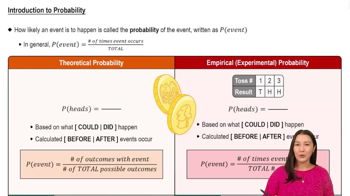
Introduction to Probability

Combinatorics

Combinatorics is a branch of mathematics dealing with combinations and permutations of objects. In lottery scenarios, it helps calculate the number of ways to choose a set of numbers from a larger pool. For example, in the Mega Millions game, combinatorial calculations are used to determine how many different combinations of five numbers can be selected from 70, which is crucial for understanding the overall odds of winning.

Independent Events

Independent events are those whose outcomes do not affect each other. In the context of the Mega Millions lottery, the selection of the five numbers and the separate selection of the single number are independent events. This concept is important when calculating the overall probability of winning, as the total probability is the product of the probabilities of each independent event occurring.
Recommended video:
05:54
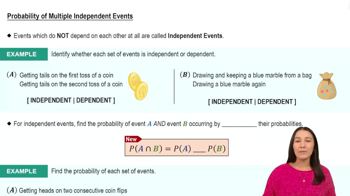
Probability of Multiple Independent Events
Related Practice
Textbook Question

Florida Pick 3 In the Florida Pick 3 lottery, you can place a “straight” bet of \(1 by selecting the exact order of three digits between 0 and 9 inclusive (with repetition allowed), so the probability of winning is 1/1000. If the same three numbers are drawn in the same order, you collect \)500, so your net profit is \$499.


c. Is there much of a difference between the actual odds against winning and the payoff odds?

117
views
Textbook Question

Births in the United States In the United States, the true probability of a baby being a boy is 0.512 (based on the data available at this writing). For a family having three children, find the following.


d. The probability that at least one of the children is a girl.

236
views
Textbook Question

Sampling Eye Color Based on a study by Dr. P. Sorita Soni at Indiana University, assume that eye colors in the United States are distributed as follows: 40% brown, 35% blue, 12% green, 7% gray, 6% hazel.


d. If two people are randomly selected, what is the probability that at least one of them has brown eyes?

139
views
Textbook Question

Subjective Probability Estimate the probability that the next time you watch a TV news report, it includes a story about a plane crash.

164
views
Textbook Question

In Exercises 21-28, find the probability and answer the questions.


X-Linked Genetic Disease Men have XY (or YX) chromosomes and women have XX chromosomes. X-linked recessive genetic diseases (such as juvenile retinoschisis) occur when there is a defective X chromosome that occurs without a paired X chromosome that is not defective. In the following, represent a defective X chromosome with lowercase x, so a child with the xY or Yx pair of chromosomes will have the disease and a child with XX or XY or YX or xX or Xx will not have the disease. Each parent contributes one of the chromosomes to the child.


c. If a mother has one defective x chromosome and one good X chromosome and the father has good XY chromosomes, what is the probability that a son will inherit the disease?

168
views
Textbook Question

Phase I of a Clinical Trial A clinical test on humans of a new drug is normally done in three phases. Phase I is conducted with a relatively small number of healthy volunteers. For example, a phase I test of bexarotene involved only 14 subjects. Assume that we want to treat 14 healthy humans with this new drug and we have 16 suitable volunteers available.


c. If 14 subjects are randomly selected and treated at the same time, what is the probability of selecting the 14 youngest subjects?

145
views