
Ch. 5 - Discrete Probability Distributions
Triola - Elementary Statistics 14th Edition
Triola14th EditionElementary StatisticsISBN: 9780137366446Not the one you use?Change textbook
Chapter 5, Problem 5.2.38e

Politics The County Clerk in Essex, New Jersey, was accused of cheating by not using randomness in assigning the order in which candidates’ names appeared on voting ballots. Among 41 different ballots, Democrats were assigned the desirable first line 40 times. Assume that Democrats and Republicans are assigned the first line using a method of random selection so that they are equally likely to get that first line.


e. What do the results suggest about how the clerk met the requirement of using a random method to assign the order of candidates’ names on voting ballots?

Verified step by step guidance
1
Step 1: Define the null hypothesis (H₀) and the alternative hypothesis (H₁). The null hypothesis assumes that the assignment of the first line is random, meaning Democrats and Republicans each have a 50% chance of being assigned the first line. The alternative hypothesis suggests that the assignment is not random.
Step 2: Identify the test to be used. Since we are dealing with a binary outcome (Democrats or Republicans) and testing whether the observed proportion significantly deviates from the expected proportion under randomness, a binomial test is appropriate.
Step 3: Calculate the expected probability under the null hypothesis. If the assignment is random, the probability of Democrats being assigned the first line is 0.5. The number of trials is 41, and the observed number of successes (Democrats getting the first line) is 40.
Step 4: Compute the p-value for the binomial test. The p-value represents the probability of observing 40 or more successes (or an extreme result) under the null hypothesis. Use the binomial probability formula or statistical software to calculate this: P(X ≥ 40) where X follows a Binomial distribution with n = 41 and p = 0.5.
Step 5: Compare the p-value to the significance level (commonly α = 0.05). If the p-value is less than α, reject the null hypothesis and conclude that the assignment of the first line is not random. If the p-value is greater than α, fail to reject the null hypothesis and conclude that there is insufficient evidence to suggest the assignment is not random.

Verified video answer for a similar problem:

This video solution was recommended by our tutors as helpful for the problem above.
Video duration:
7m
Was this helpful?

Key Concepts

Here are the essential concepts you must grasp in order to answer the question correctly.

Randomness

Randomness refers to the lack of pattern or predictability in events. In the context of assigning candidates' names on ballots, a random method ensures that each candidate has an equal chance of being placed in any position. This is crucial for fairness in elections, as it prevents bias in the order of names that could influence voter choice.
Recommended video:
Guided course
07:09
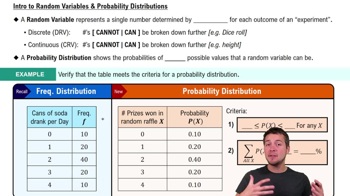
Intro to Random Variables & Probability Distributions

Probability

Probability is a measure of the likelihood that a particular event will occur, expressed as a number between 0 and 1. In this scenario, if the assignment of names is random, each candidate should have a 50% chance of being placed first. The observed frequency of Democrats appearing first 40 out of 41 times suggests a deviation from expected probability, raising concerns about the randomness of the selection process.
Recommended video:
5:37
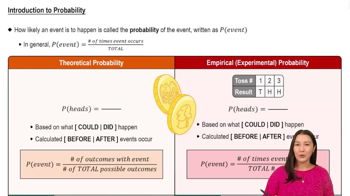
Introduction to Probability

Statistical Significance

Statistical significance assesses whether the results observed in a study are likely due to chance or if they indicate a true effect. In this case, the extreme frequency of Democrats being assigned the first line suggests that the method used by the clerk may not have been random. A statistical test could be applied to determine if the observed results are significantly different from what would be expected under a fair random assignment.
Recommended video:
Guided course
05:53
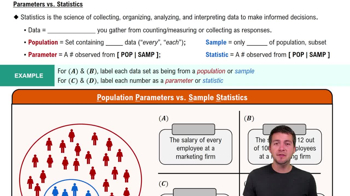
Parameters vs. Statistics
Related Practice
Textbook Question

In Exercises 6–10, refer to the accompanying table, which describes the numbers of adults in groups of five who reported sleepwalking (based on data from “Prevalence and Comorbidity of Nocturnal Wandering In the U.S. Adult General Population,” by Ohayon et al., Neurology, Vol. 78, No. 20).


Probability Find the probability that at least one of the subjects is a sleepwalker.

158
views
Textbook Question

In Exercises 25–28, find the probabilities and answer the questions.


Too Young to Tat Based on a Harris poll, among adults who regret getting tattoos, 20% say that they were too young when they got their tattoos. Assume that five adults who regret getting tattoos are randomly selected, and find the indicated probability.


d. If we randomly select five adults, is 1 a significantly low number who say that they were too young to get tattoos?

131
views
Textbook Question

Expected Value in North Carolina’s Pick 4 Game In North Carolina’s Pick 4 lottery game, you can pay \(1 to select a four-digit number from 0000 through 9999. If you select the same sequence of four digits that are drawn, you win and collect \)5000.


e. If you bet \$1 in North Carolina’s Pick 3 game, the expected value is Which bet is better in the sense of a producing a higher expected value: A \$1 bet in the North Carolina Pick 4 game or a \$1 bet in the North Carolina Pick 3 game?

179
views
Textbook Question

Using Probabilities for Significant Events


d. Is 1 a significantly low number of matches? Why or why not?

179
views
Textbook Question

 In Exercises 5–8, assume that the Poisson distribution applies; assume that the mean number of Atlantic hurricanes in the United States is 5.5 per year, as in Example 1; and proceed to find the indicated probability.


Hurricanes


a. Find the probability that in a year, there will be no hurricanes.

141
views
Textbook Question

In Exercises 6–10, refer to the accompanying table, which describes the numbers of adults in groups of five who reported sleepwalking (based on data from “Prevalence and Comorbidity of Nocturnal Wandering In the U.S. Adult General Population,” by Ohayon et al., Neurology, Vol. 78, No. 20).


Does the table describe a probability distribution?

187
views