Ch. 5 - Discrete Probability Distributions
Triola - Elementary Statistics 14th Edition
Triola14th EditionElementary StatisticsISBN: 9780137366446Not the one you use?Change textbook
Chapter 5, Problem 5.q.6

In Exercises 6–10, refer to the accompanying table, which describes the numbers of adults in groups of five who reported sleepwalking (based on data from “Prevalence and Comorbidity of Nocturnal Wandering In the U.S. Adult General Population,” by Ohayon et al., Neurology, Vol. 78, No. 20).


Does the table describe a probability distribution?

Verified step by step guidance
1
Step 1: Understand the requirements for a probability distribution. A probability distribution must satisfy two conditions: (1) The sum of all probabilities must equal 1, and (2) each probability value must be between 0 and 1 inclusive.
Step 2: Examine the table provided. The table lists values of x (the number of adults reporting sleepwalking) and their corresponding probabilities P(x). Verify that all P(x) values are between 0 and 1.
Step 3: Add up all the probabilities in the table: P(0) + P(1) + P(2) + P(3) + P(4) + P(5). Use the values provided in the table: 0.172 + 0.363 + 0.306 + 0.129 + 0.027 + 0.002.
Step 4: Check if the sum of the probabilities equals 1. If the sum is exactly 1, the first condition for a probability distribution is satisfied.
Step 5: Confirm that all probabilities are between 0 and 1 inclusive. If both conditions are satisfied, then the table describes a probability distribution.

Verified video answer for a similar problem:

This video solution was recommended by our tutors as helpful for the problem above.
Video duration:
2m
Was this helpful?

Key Concepts

Here are the essential concepts you must grasp in order to answer the question correctly.

Probability Distribution

A probability distribution describes how the probabilities of a random variable are distributed across its possible values. It provides a complete description of the likelihood of each outcome occurring. In this case, the table lists the number of adults who reported sleepwalking (x) and their corresponding probabilities (P(x)), which collectively form a discrete probability distribution.
Recommended video:
Guided course
06:39
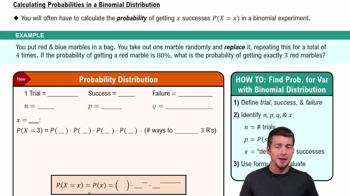
Calculating Probabilities in a Binomial Distribution

Properties of Probability

For a set of probabilities to represent a valid probability distribution, two key properties must be satisfied: each probability must be between 0 and 1, and the sum of all probabilities must equal 1. In the provided table, we can check these properties to determine if the data indeed forms a valid probability distribution.
Recommended video:
5:37
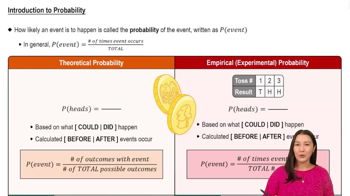
Introduction to Probability

Discrete Random Variable

A discrete random variable is a variable that can take on a countable number of distinct values, often representing counts or categories. In this context, the variable x represents the number of adults in groups of five who reported sleepwalking, making it a discrete random variable. Understanding this concept is essential for analyzing the associated probability distribution.
Recommended video:
Guided course
04:48
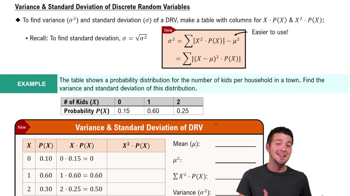
Variance & Standard Deviation of Discrete Random Variables
Related Practice
Textbook Question

In Exercises 6–10, refer to the accompanying table, which describes the numbers of adults in groups of five who reported sleepwalking (based on data from “Prevalence and Comorbidity of Nocturnal Wandering In the U.S. Adult General Population,” by Ohayon et al., Neurology, Vol. 78, No. 20).


Probability Find the probability that at least one of the subjects is a sleepwalker.

158
views
Textbook Question

 In Exercises 5–8, assume that the Poisson distribution applies; assume that the mean number of Atlantic hurricanes in the United States is 5.5 per year, as in Example 1; and proceed to find the indicated probability.


Hurricanes


b. In a 118-year period, how many years are expected to have no hurricanes?

130
views
Textbook Question

Texting and Driving. In Exercises 21–26, refer to the accompanying table, which describes probabilities for groups of five drivers. The random variable x is the number of drivers in a group who say that they text while driving (based on data from an Arity survey of drivers).

For groups of five drivers, find the mean and standard deviation for the numbers of drivers who say that they text while driving.

82
views
Textbook Question

Expected Value in North Carolina’s Pick 4 Game In North Carolina’s Pick 4 lottery game, you can pay \(1 to select a four-digit number from 0000 through 9999. If you select the same sequence of four digits that are drawn, you win and collect \)5000.


e. If you bet \$1 in North Carolina’s Pick 3 game, the expected value is Which bet is better in the sense of a producing a higher expected value: A \$1 bet in the North Carolina Pick 4 game or a \$1 bet in the North Carolina Pick 3 game?

179
views
Textbook Question

Politics The County Clerk in Essex, New Jersey, was accused of cheating by not using randomness in assigning the order in which candidates’ names appeared on voting ballots. Among 41 different ballots, Democrats were assigned the desirable first line 40 times. Assume that Democrats and Republicans are assigned the first line using a method of random selection so that they are equally likely to get that first line.


e. What do the results suggest about how the clerk met the requirement of using a random method to assign the order of candidates’ names on voting ballots?

106
views
Textbook Question

 In Exercises 5–8, assume that the Poisson distribution applies; assume that the mean number of Atlantic hurricanes in the United States is 5.5 per year, as in Example 1; and proceed to find the indicated probability.


Hurricanes


a. Find the probability that in a year, there will be no hurricanes.

141
views