Ch. 6 - Normal Probability Distributions
Triola - Elementary Statistics 14th Edition
Triola14th EditionElementary StatisticsISBN: 9780137366446Not the one you use?Change textbook
Chapter 6, Problem 6.1.45

Basis for the Range Rule of Thumb and the Empirical Rule. In Exercises 45–48, find the indicated area under the curve of the standard normal distribution; then convert it to a percentage and fill in the blank. The results form the basis for the range rule of thumb and the empirical rule introduced in Section 3-2.


About __ % of the area is between z = -1 and z = 1 (or within 1 standard deviation of the mean).

Verified step by step guidance
1
Step 1: Understand the problem. The question asks us to find the area under the standard normal distribution curve between z = -1 and z = 1. This corresponds to the proportion of data within 1 standard deviation of the mean in a standard normal distribution.
Step 2: Recall the properties of the standard normal distribution. The standard normal distribution is symmetric about the mean (z = 0), and the total area under the curve is 1, representing 100% of the data.
Step 3: Use the z-scores provided (z = -1 and z = 1) to find the cumulative probabilities. The cumulative probability for a z-score represents the area under the curve to the left of that z-score. To find the area between z = -1 and z = 1, calculate the cumulative probability for z = 1 and subtract the cumulative probability for z = -1.
Step 4: Use a standard normal distribution table or a statistical software tool to find the cumulative probabilities. For z = 1, the cumulative probability is approximately 0.8413, and for z = -1, the cumulative probability is approximately 0.1587.
Step 5: Subtract the cumulative probability for z = -1 from the cumulative probability for z = 1 to find the area between z = -1 and z = 1. Multiply the result by 100 to convert it to a percentage. This percentage represents the proportion of data within 1 standard deviation of the mean.

Verified video answer for a similar problem:

This video solution was recommended by our tutors as helpful for the problem above.
Video duration:
1m
Was this helpful?

Key Concepts

Here are the essential concepts you must grasp in order to answer the question correctly.

Standard Normal Distribution

The standard normal distribution is a special normal distribution with a mean of 0 and a standard deviation of 1. It is used to determine probabilities and areas under the curve for any normal distribution by converting raw scores (z-scores) into standard scores. This allows for the application of the empirical rule and other statistical analyses.
Recommended video:
Guided course
09:47
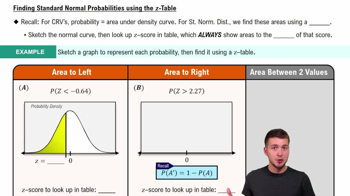
Finding Standard Normal Probabilities using z-Table

Empirical Rule

The empirical rule, also known as the 68-95-99.7 rule, states that for a normal distribution, approximately 68% of the data falls within one standard deviation of the mean, about 95% within two standard deviations, and about 99.7% within three standard deviations. This rule helps in understanding the spread of data and is foundational for making predictions based on normal distributions.
Recommended video:
5:14
Probability of Mutually Exclusive Events

Range Rule of Thumb

The range rule of thumb is a guideline that suggests the range of a data set can be estimated as four times the standard deviation. This rule provides a quick way to assess the variability of data and is particularly useful in the context of the empirical rule, as it helps to understand how much of the data lies within certain standard deviations from the mean.
Recommended video:
5:14
Probability of Mutually Exclusive Events
Related Practice
Textbook Question

Small Sample Weights of M&M plain candies are normally distributed. Twelve M&M plain candies are randomly selected and weighed, and then the mean of this sample is calculated. Is it correct to conclude that the resulting sample mean cannot be considered to be a value from a normally distributed population because the sample size of 12 is too small? Explain.

137
views
Textbook Question

Tennis Replay In a recent year, there were 879 challenges made to referee calls in professional tennis singles play. Among those challenges, 231 challenges were upheld with the call overturned. Assume that in general, 25% of the challenges are successfully upheld with the call overturned.


a. If the 25% rate is correct, find the probability that among the 879 challenges, the number of overturned calls is exactly 231.

122
views
Textbook Question

Finding Bone Density Scores. In Exercises 37–40 assume that a randomly selected subject is given a bone density test. Bone density test scores are normally distributed with a mean of 0 and a standard deviation of 1. In each case, draw a graph, then find the bone density test score corresponding to the given information. Round results to two decimal places.


Find the bone density scores that are the quartiles Q1, Q2, and Q3.

136
views
Textbook Question

Pulse Rates. In Exercises 13–24, use the data in the table below for pulse rates of adult males and females (based on Data Set 1 “Body Data” in Appendix B). Hint: Draw a graph in each case.


" style="" width="340">


Find the probability that a male has a pulse rate between 70 beats per minute and 90 beats per minute.

390
views
Textbook Question

Satisfying Requirements Data Set 1 “Body Data” in Appendix B includes a sample of 147 pulse rates of randomly selected women. Does that sample satisfy the following requirement: (1) The sample appears to be from a normally distributed population; or (2) the sample has a size of n>30?

162
views
Textbook Question

IQ Scores. In Exercises 5–8, find the area of the shaded region. The graphs depict IQ scores of adults, and those scores are normally distributed with a mean of 100 and a standard deviation of 15 (as on the Wechsler IQ test).

204
views