
Ch. 6 - Normal Probability Distributions
Triola - Elementary Statistics 14th Edition
Triola14th EditionElementary StatisticsISBN: 9780137366446Not the one you use?Change textbook
Chapter 6, Problem 6.2.19

Pulse Rates. In Exercises 13–24, use the data in the table below for pulse rates of adult males and females (based on Data Set 1 “Body Data” in Appendix B). Hint: Draw a graph in each case.


<IMAGE>


Find the probability that a male has a pulse rate between 70 beats per minute and 90 beats per minute.

Verified step by step guidance
1
Identify the given information: The pulse rates of males follow a normal distribution with a mean (μ) of 69.6 beats per minute and a standard deviation (σ) of 11.3 beats per minute. We are tasked with finding the probability that a male has a pulse rate between 70 and 90 beats per minute.
Standardize the pulse rates of 70 and 90 using the z-score formula: z = (X - μ) / σ, where X is the value of interest, μ is the mean, and σ is the standard deviation. Calculate the z-scores for X = 70 and X = 90.
Use the z-scores obtained in the previous step to find the cumulative probabilities from the standard normal distribution table (or a calculator). These cumulative probabilities represent the area under the normal curve to the left of each z-score.
To find the probability that a male has a pulse rate between 70 and 90, subtract the cumulative probability corresponding to the z-score for 70 from the cumulative probability corresponding to the z-score for 90. This gives the area under the curve between these two z-scores.
Interpret the result: The final probability represents the likelihood that a randomly selected male has a pulse rate between 70 and 90 beats per minute. Ensure the result is expressed as a decimal or percentage, depending on the context.

Verified video answer for a similar problem:

This video solution was recommended by our tutors as helpful for the problem above.
Video duration:
4m
Was this helpful?

Key Concepts

Here are the essential concepts you must grasp in order to answer the question correctly.

Normal Distribution

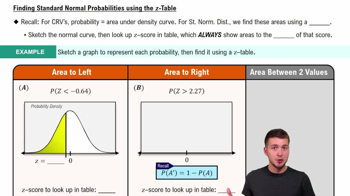
Normal distribution is a probability distribution that is symmetric about the mean, showing that data near the mean are more frequent in occurrence than data far from the mean. In this context, both male and female pulse rates are assumed to follow a normal distribution, which allows for the use of statistical methods to calculate probabilities and make inferences about the population.
Recommended video:
Guided course
09:47
Finding Standard Normal Probabilities using z-Table

Mean and Standard Deviation

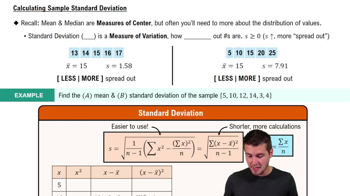
The mean is the average value of a dataset, while the standard deviation measures the amount of variation or dispersion from the mean. For males, the mean pulse rate is 69.6 beats per minute with a standard deviation of 11.3, indicating how pulse rates vary among adult males. These statistics are essential for understanding the distribution of pulse rates and calculating probabilities.
Recommended video:
Guided course
08:45
Calculating Standard Deviation

Probability Calculation

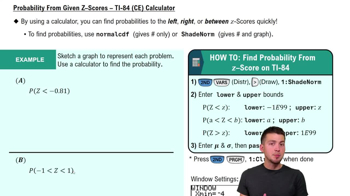
Probability calculation involves determining the likelihood of a specific event occurring within a defined set of outcomes. In this case, finding the probability that a male has a pulse rate between 70 and 90 beats per minute requires using the properties of the normal distribution, including the mean and standard deviation, to find the area under the curve within that range.
Recommended video:
Guided course
07:09
Probability From Given Z-Scores - TI-84 (CE) Calculator
Related Practice
Textbook Question

Small Sample Weights of M&M plain candies are normally distributed. Twelve M&M plain candies are randomly selected and weighed, and then the mean of this sample is calculated. Is it correct to conclude that the resulting sample mean cannot be considered to be a value from a normally distributed population because the sample size of 12 is too small? Explain.

137
views
Textbook Question

Basis for the Range Rule of Thumb and the Empirical Rule. In Exercises 45–48, find the indicated area under the curve of the standard normal distribution; then convert it to a percentage and fill in the blank. The results form the basis for the range rule of thumb and the empirical rule introduced in Section 3-2.


About __ % of the area is between z = -1 and z = 1 (or within 1 standard deviation of the mean).

163
views
Textbook Question

Finding Bone Density Scores. In Exercises 37–40 assume that a randomly selected subject is given a bone density test. Bone density test scores are normally distributed with a mean of 0 and a standard deviation of 1. In each case, draw a graph, then find the bone density test score corresponding to the given information. Round results to two decimal places.


Find the bone density scores that are the quartiles Q1, Q2, and Q3.

136
views
Textbook Question

Satisfying Requirements Data Set 1 “Body Data” in Appendix B includes a sample of 147 pulse rates of randomly selected women. Does that sample satisfy the following requirement: (1) The sample appears to be from a normally distributed population; or (2) the sample has a size of n>30?

162
views
Textbook Question

Standard Normal Distribution. In Exercises 17–36, assume that a randomly selected subject is given a bone density test. Those test scores are normally distributed with a mean of 0 and a standard deviation of 1. In each case, draw a graph, then find the probability of the given bone density test scores. If using technology instead of Table A-2, round answers to four decimal places.


Less than -2.00

207
views
Textbook Question

Continuous Uniform Distribution. In Exercises 5–8, refer to the continuous uniform distribution depicted in Figure 6-2 and described in Example 1. Assume that a passenger is randomly selected, and find the probability that the waiting time is within the given range.


" style="" width="225">


Greater than 3.00 minutes

363
views