Ch. 6 - Normal Probability Distributions
Triola - Elementary Statistics 14th Edition
Triola14th EditionElementary StatisticsISBN: 9780137366446Not the one you use?Change textbook
Chapter 6, Problem 6.6.10

Car Colors
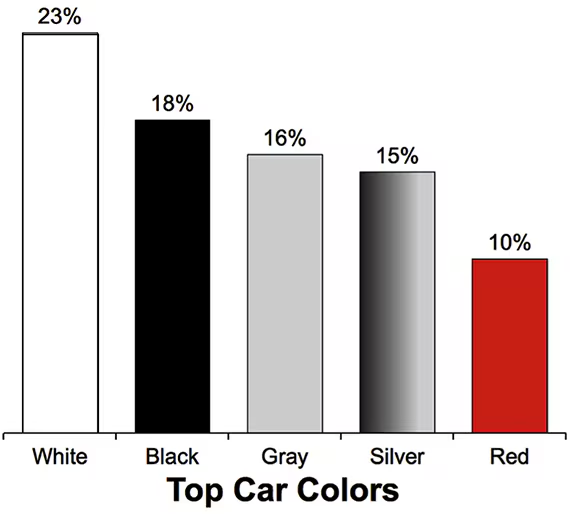
In Exercises 9–12, assume that 100 cars are randomly selected. Refer to the accompanying graph, which shows the top car colors and the percentages of cars with those colors (based on PPG Industries).


Bar graph showing top car colors: White 23%, Black 18%, Gray 16%, Silver 15%, Red 10%.


Black Cars Find the probability that at least 25 cars are black. Is 25 a significantly high number of black cars?

Verified step by step guidance
1
Step 1: Identify the probability of selecting a black car from the graph. The graph shows that 18% of cars are black, which corresponds to a probability of 0.18.
Step 2: Define the random variable X as the number of black cars in a sample of 100 cars. Since the selection is random, X follows a binomial distribution with parameters n = 100 (number of trials) and p = 0.18 (probability of success).
Step 3: To find the probability that at least 25 cars are black, calculate P(X ≥ 25). This can be expressed as 1 - P(X ≤ 24). Use the cumulative probability formula for the binomial distribution or a statistical software/calculator to compute P(X ≤ 24).
Step 4: To determine if 25 is a significantly high number of black cars, calculate the mean and standard deviation of the binomial distribution. The mean is μ = n * p = 100 * 0.18, and the standard deviation is σ = √(n * p * (1 - p)) = √(100 * 0.18 * 0.82).
Step 5: Use the rule of thumb for significant values: a value is considered significantly high if it is greater than μ + 2σ. Compare 25 to μ + 2σ to determine if it is significantly high.

Verified video answer for a similar problem:

This video solution was recommended by our tutors as helpful for the problem above.
Video duration:
6m
Was this helpful?

Key Concepts

Here are the essential concepts you must grasp in order to answer the question correctly.

Probability

Probability is a measure of the likelihood that a particular event will occur, expressed as a number between 0 and 1. In this context, it involves calculating the chance of selecting at least 25 black cars from a sample of 100, based on the percentage of black cars (18%) in the population. Understanding probability helps in making informed predictions about outcomes in random sampling.
Recommended video:
5:37
Introduction to Probability

Binomial Distribution

The binomial distribution is a statistical distribution that describes the number of successes in a fixed number of independent Bernoulli trials, each with the same probability of success. In this scenario, selecting black cars can be modeled using a binomial distribution, where 'success' is defined as selecting a black car. This concept is crucial for determining the probability of observing at least 25 black cars in the sample.
Recommended video:
Guided course
03:28
Mean & Standard Deviation of Binomial Distribution

Statistical Significance

Statistical significance refers to the likelihood that a result or relationship is caused by something other than mere random chance. In this question, determining whether 25 black cars is a significantly high number involves comparing the observed frequency against what would be expected under the binomial distribution. This helps in assessing whether the observed outcome is unusual or expected based on the given probabilities.
Recommended video:
Guided course
05:53
Parameters vs. Statistics
Related Practice
Textbook Question

Standard Normal Distribution. In Exercises 13–16, find the indicated z score. The graph depicts the standard normal distribution of bone density scores with mean 0 and standard deviation 1.


265
views
Textbook Question

Outliers For the purposes of constructing modified boxplots as described in Section 3-3, outliers are defined as data values that are above Q3 by an amount greater than 1.5 x IQR or below Q1 by an amount greater than 1.5 x IQR, where IQR is the interquartile range. Using this definition of outliers, find the probability that when a value is randomly selected from a normal distribution, it is an outlier.

209
views
Textbook Question

Determining Normality. In Exercises 9–12, refer to the indicated sample data and determine whether they appear to be from a population with a normal distribution. Assume that this requirement is loose in the sense that the population distribution need not be exactly normal, but it must be a distribution that is roughly bell-shaped.


Taxi Trips The distances (miles) traveled by New York City taxis transporting customers, as listed in Data Set 32 “Taxis” in Appendix B

163
views
Textbook Question

Standard Normal Distribution. In Exercises 17–36, assume that a randomly selected subject is given a bone density test. Those test scores are normally distributed with a mean of 0 and a standard deviation of 1. In each case, draw a graph, then find the probability of the given bone density test scores. If using technology instead of Table A-2, round answers to four decimal places.


Between 1.50 and 2.00

185
views
Textbook Question

Constructing Normal Quantile Plots. In Exercises 17–20, use the given data values to identify the corresponding z scores that are used for a normal quantile plot, then identify the coordinates of each point in the normal quantile plot. Construct the normal quantile plot, then determine whether the data appear to be from a population with a normal distribution.


Earthquake Depths A sample of depths (km) of earthquakes is obtained from Data Set 24 “Earthquakes” in Appendix B: 17.3, 7.0, 7.0, 7.0, 8.1, 6.8.

139
views
Textbook Question

Finding Bone Density Scores. In Exercises 37–40 assume that a randomly selected subject is given a bone density test. Bone density test scores are normally distributed with a mean of 0 and a standard deviation of 1. In each case, draw a graph, then find the bone density test score corresponding to the given information. Round results to two decimal places.


Find P99, the 99th percentile. This is the bone density score separating the bottom 99% from the top 1%.

184
views