Ch. 6 - Normal Probability Distributions
Triola - Elementary Statistics 14th Edition
Triola14th EditionElementary StatisticsISBN: 9780137366446Not the one you use?Change textbook
Chapter 6, Problem 6.1.13

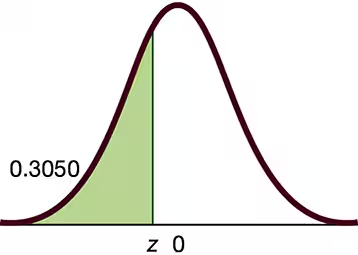
Standard Normal Distribution. In Exercises 13–16, find the indicated z score. The graph depicts the standard normal distribution of bone density scores with mean 0 and standard deviation 1.


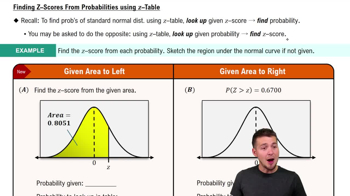
Standard normal distribution curve with shaded area left of z=0, representing probability 0.3050.

Verified step by step guidance
1
Step 1: Understand the problem. The graph represents a standard normal distribution with a mean of 0 and a standard deviation of 1. The shaded area to the left of the z-score corresponds to a cumulative probability of 0.3050.
Step 2: Recall the relationship between z-scores and cumulative probabilities. The z-score is the value on the horizontal axis of the standard normal distribution that corresponds to a given cumulative probability.
Step 3: Use a standard normal distribution table or a statistical software/tool to find the z-score that corresponds to a cumulative probability of 0.3050. This involves looking up the cumulative probability in the table and identifying the associated z-score.
Step 4: Note that the cumulative probability represents the area under the curve to the left of the z-score. Ensure that the table or tool you use is designed for the standard normal distribution.
Step 5: Verify your result by checking that the cumulative probability for the identified z-score matches 0.3050. This ensures accuracy in your calculation.

Verified video answer for a similar problem:

This video solution was recommended by our tutors as helpful for the problem above.
Video duration:
2m
Was this helpful?

Key Concepts

Here are the essential concepts you must grasp in order to answer the question correctly.

Standard Normal Distribution

The standard normal distribution is a special case of the normal distribution where the mean is 0 and the standard deviation is 1. It is represented by the bell-shaped curve, which is symmetric about the mean. This distribution is crucial for statistical analysis as it allows for the calculation of probabilities and z-scores, which indicate how many standard deviations an element is from the mean.
Recommended video:
Guided course
09:47
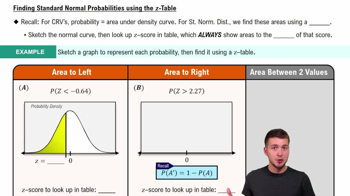
Finding Standard Normal Probabilities using z-Table

Z-Score

A z-score is a statistical measurement that describes a value's relationship to the mean of a group of values. It is calculated by subtracting the mean from the value and then dividing by the standard deviation. Z-scores are essential for understanding how far away a particular score is from the average, allowing for comparisons across different datasets.
Recommended video:
Guided course
06:31
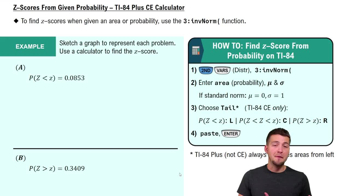
Z-Scores From Given Probability - TI-84 (CE) Calculator

Area Under the Curve

In the context of the normal distribution, the area under the curve represents the probability of a random variable falling within a particular range. The total area under the curve equals 1, and specific areas correspond to probabilities associated with z-scores. For example, the shaded area in the provided graph indicates the probability of obtaining a z-score less than 0, which is 0.3050.
Recommended video:
Guided course
08:50
Z-Scores from Probabilities
Related Practice
Textbook Question

Car Colors

In Exercises 9–12, assume that 100 cars are randomly selected. Refer to the accompanying graph, which shows the top car colors and the percentages of cars with those colors (based on PPG Industries).


Black Cars Find the probability that at least 25 cars are black. Is 25 a significantly high number of black cars?

125
views
Textbook Question

Outliers For the purposes of constructing modified boxplots as described in Section 3-3, outliers are defined as data values that are above Q3 by an amount greater than 1.5 x IQR or below Q1 by an amount greater than 1.5 x IQR, where IQR is the interquartile range. Using this definition of outliers, find the probability that when a value is randomly selected from a normal distribution, it is an outlier.

209
views
Textbook Question

Determining Normality. In Exercises 9–12, refer to the indicated sample data and determine whether they appear to be from a population with a normal distribution. Assume that this requirement is loose in the sense that the population distribution need not be exactly normal, but it must be a distribution that is roughly bell-shaped.


Taxi Trips The distances (miles) traveled by New York City taxis transporting customers, as listed in Data Set 32 “Taxis” in Appendix B

163
views
Textbook Question

Basis for the Range Rule of Thumb and the Empirical Rule. In Exercises 45–48, find the indicated area under the curve of the standard normal distribution; then convert it to a percentage and fill in the blank. The results form the basis for the range rule of thumb and the empirical rule introduced in Section 3-2.


About __ % of the area is between z = -3.5 and z = 3.5 (or within 3.5 standard deviation of the mean).

184
views
Textbook Question

In Exercises 1 and 2, use the following wait times (minutes) at 10:00 AM for the Tower of Terror ride at Disney World (from Data Set 33 “Disney World Wait Times” in Appendix B).


35 35 20 50 95 75 45 50 30 35 30 30


h. Are the wait times discrete data or continuous data?

272
views
Textbook Question

Foot Lengths of Women Assume that foot lengths of adult females are normally distributed with a mean of 246.3 mm and a standard deviation of 12.4 mm (based on Data Set 3 “ANSUR II 2012” in Appendix B).


a. Find the probability that a randomly selected adult female has a foot length less than 221.5 mm.

149
views