


Ch. 6 - Normal Probability Distributions
Triola - Elementary Statistics 14th Edition
Triola14th EditionElementary StatisticsISBN: 9780137366446Not the one you use?Change textbook
Chapter 6, Problem 6.6.1c

Continuity Correction In testing the assumption that the probability of a baby boy is 0.512, a geneticist obtains a random sample of 1000 births and finds that 502 of them are boys. Using the continuity correction, describe the area under the graph of a normal distribution corresponding to the following. (For example, the area corresponding to “the probability of at least 502 boys” is this: the area to the right of 501.5.)


c. The probability of more than 502 boys

Verified step by step guidance
1
Step 1: Understand the concept of continuity correction. In a binomial distribution, when approximating probabilities using a normal distribution, a continuity correction is applied to account for the discrete nature of the binomial variable. This involves adjusting the value by ±0.5 depending on the inequality being considered.
Step 2: Identify the inequality in the problem. The problem asks for the probability of 'more than 502 boys.' In terms of the normal distribution, this corresponds to the area to the right of 502.5 (adjusted using the continuity correction).
Step 3: Calculate the mean (μ) and standard deviation (σ) of the binomial distribution. The mean is given by μ = n * p, where n is the sample size (1000) and p is the probability of a boy (0.512). The standard deviation is calculated as σ = √(n * p * (1 - p)).
Step 4: Convert the adjusted value (502.5) into a z-score using the formula: z = (X - μ) / σ, where X is the adjusted value, μ is the mean, and σ is the standard deviation. This z-score represents the number of standard deviations the value is away from the mean.
Step 5: Use the z-score to find the corresponding probability. Look up the z-score in a standard normal distribution table or use statistical software to find the area to the right of the z-score. This area represents the probability of more than 502 boys.

Verified video answer for a similar problem:

This video solution was recommended by our tutors as helpful for the problem above.
Video duration:
1m
Was this helpful?

Key Concepts

Here are the essential concepts you must grasp in order to answer the question correctly.

Normal Distribution

The normal distribution is a continuous probability distribution characterized by its bell-shaped curve, defined by its mean and standard deviation. It is widely used in statistics because many phenomena tend to follow this distribution. In hypothesis testing, the normal distribution helps approximate the behavior of sample proportions, especially with large sample sizes, allowing for easier calculation of probabilities.
Recommended video:
Guided course
09:47
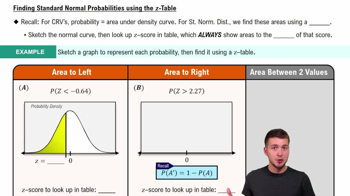
Finding Standard Normal Probabilities using z-Table

Continuity Correction

Continuity correction is a technique used when a discrete distribution is approximated by a continuous distribution, such as the normal distribution. It involves adjusting the discrete values by 0.5 to account for the fact that continuous distributions can take on any value within a range, while discrete distributions can only take specific values. This correction improves the accuracy of probability estimates, particularly in binomial distributions.
Recommended video:
06:23
Using the Normal Distribution to Approximate Binomial Probabilities

Probability Calculation

Probability calculation involves determining the likelihood of a specific outcome occurring within a given set of conditions. In the context of the question, it refers to finding the area under the normal distribution curve that corresponds to the event of having more than 502 boys in a sample of 1000 births. This is done by calculating the z-score and using standard normal distribution tables or software to find the corresponding probabilities.
Recommended video:
Guided course
07:09
Probability From Given Z-Scores - TI-84 (CE) Calculator
Related Practice
Textbook Question

In Exercises 1 and 2, use the following wait times (minutes) at 10:00 AM for the Tower of Terror ride at Disney World (from Data Set 33 “Disney World Wait Times” in Appendix B).


35 35 20 50 95 75 45 50 30 35 30 30


Tower of Terror Wait Times


a. Find Q1, Q2 and Q3.

134
views
Textbook Question

In Exercises 1 and 2, use the following wait times (minutes) at 10:00 AM for the Tower of Terror ride at Disney World (from Data Set 33 “Disney World Wait Times” in Appendix B).


35 35 20 50 95 75 45 50 30 35 30 30


d. Find the variance.

97
views
Textbook Question

Hershey Kisses Based on Data Set 38 “Candies” in Appendix B, weights of the chocolate in Hershey Kisses are normally distributed with a mean of 4.5338 g and a standard deviation of 0.1039 g


d. What is the value of the variance?

173
views
Textbook Question

Significance For bone density scores that are normally distributed with a mean of 0 and a standard deviation of 1, find the percentage of scores that are


c. not significant (or less than 2 standard deviations away from the mean).

165
views
Textbook Question

Sleepwalking Assume that 29.2% of people have sleepwalked (based on “Prevalence and Comorbidity of Nocturnal Wandering in the U.S. Adult General Population, by Ohayon et al., Neurology, Vol. 78, No. 20). Assume that in a random sample of 1480 adults, 455 have sleepwalked.


c. What does the result suggest about the rate of 29.2%?

99
views
Textbook Question

Ergonomics. Exercises 9–16 involve applications to ergonomics, as described in the Chapter Problem.


Doorway Height The Boeing 757-200 ER airliner carries 200 passengers and has doors with a height of 72 in. Heights of men are normally distributed with a mean of 68.6 in. and a standard deviation of 2.8 in. (based on Data Set 1 “Body Data” in Appendix B).


d. When considering the comfort and safety of passengers, why are women ignored in this case?

98
views