Ch. 6 - Normal Probability Distributions
Triola - Elementary Statistics 14th Edition
Triola14th EditionElementary StatisticsISBN: 9780137366446Not the one you use?Change textbook
Chapter 6, Problem 6.2.2d

Hershey Kisses Based on Data Set 38 “Candies” in Appendix B, weights of the chocolate in Hershey Kisses are normally distributed with a mean of 4.5338 g and a standard deviation of 0.1039 g


d. What is the value of the variance?

Verified step by step guidance
1
Understand the relationship between standard deviation and variance. Variance is the square of the standard deviation. Mathematically, this is expressed as \( \text{Variance} = (\text{Standard Deviation})^2 \).
Identify the given standard deviation from the problem. Here, the standard deviation is \( 0.1039 \) grams.
Substitute the given standard deviation into the formula for variance: \( \text{Variance} = (0.1039)^2 \).
Perform the squaring operation to calculate the variance. This involves multiplying \( 0.1039 \) by itself.
The result of the squaring operation will give you the variance, which represents the spread of the data in squared units (grams squared).

Verified video answer for a similar problem:

This video solution was recommended by our tutors as helpful for the problem above.
Video duration:
1m
Was this helpful?

Key Concepts

Here are the essential concepts you must grasp in order to answer the question correctly.

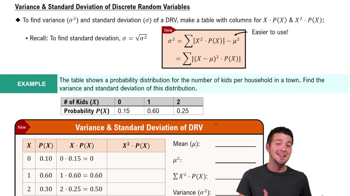
Variance

Variance is a statistical measure that represents the degree of spread or dispersion of a set of values. It quantifies how much the individual data points differ from the mean of the dataset. In the context of a normal distribution, variance is calculated as the square of the standard deviation, providing insight into the variability of the weights of Hershey Kisses.
Recommended video:
Guided course
04:48
Variance & Standard Deviation of Discrete Random Variables

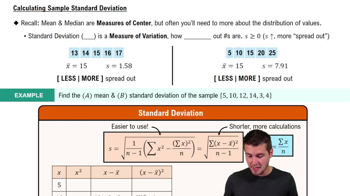
Standard Deviation

Standard deviation is a measure of the amount of variation or dispersion in a set of values. It indicates how much individual data points deviate from the mean. A low standard deviation means that the data points tend to be close to the mean, while a high standard deviation indicates a wider spread of values. In this case, the standard deviation of 0.1039 g is crucial for calculating the variance.
Recommended video:
Guided course
08:45
Calculating Standard Deviation

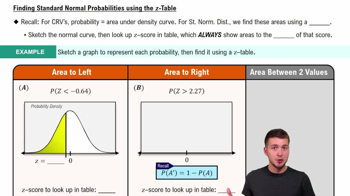
Normal Distribution

Normal distribution is a probability distribution that is symmetric about the mean, showing that data near the mean are more frequent in occurrence than data far from the mean. It is characterized by its bell-shaped curve and is defined by two parameters: the mean and the standard deviation. Understanding that the weights of Hershey Kisses follow a normal distribution helps in applying statistical methods to analyze their variance.
Recommended video:
Guided course
09:47
Finding Standard Normal Probabilities using z-Table
Related Practice
Textbook Question

Continuity Correction In testing the assumption that the probability of a baby boy is 0.512, a geneticist obtains a random sample of 1000 births and finds that 502 of them are boys. Using the continuity correction, describe the area under the graph of a normal distribution corresponding to the following. (For example, the area corresponding to “the probability of at least 502 boys” is this: the area to the right of 501.5.)


c. The probability of more than 502 boys

154
views
Textbook Question

Significance For bone density scores that are normally distributed with a mean of 0 and a standard deviation of 1, find the percentage of scores that are


c. not significant (or less than 2 standard deviations away from the mean).

165
views
Textbook Question

Bone Density Test. In Exercises 1–4, assume that scores on a bone mineral density test are normally distributed with a mean of 0 and a standard deviation of 1.


Bone Density Find the bone density score that is the 90th percentile, which is the score separating the lowest 90% from the top 10%.

101
views
Textbook Question

Sleepwalking Assume that 29.2% of people have sleepwalked (based on “Prevalence and Comorbidity of Nocturnal Wandering in the U.S. Adult General Population, by Ohayon et al., Neurology, Vol. 78, No. 20). Assume that in a random sample of 1480 adults, 455 have sleepwalked.


c. What does the result suggest about the rate of 29.2%?

99
views
Textbook Question

Ergonomics. Exercises 9–16 involve applications to ergonomics, as described in the Chapter Problem.


Doorway Height The Boeing 757-200 ER airliner carries 200 passengers and has doors with a height of 72 in. Heights of men are normally distributed with a mean of 68.6 in. and a standard deviation of 2.8 in. (based on Data Set 1 “Body Data” in Appendix B).


d. When considering the comfort and safety of passengers, why are women ignored in this case?

98
views
Textbook Question

Ergonomics. Exercises 9–16 involve applications to ergonomics, as described in the Chapter Problem.


Water Taxi Safety Passengers died when a water taxi sank in Baltimore’s Inner Harbor. Men are typically heavier than women and children, so when loading a water taxi, assume a worst-case scenario in which all passengers are men. Assume that weights of men are normally distributed with a mean of 189 lb and a standard deviation of 39 lb (based on Data Set 1 “Body Data” in Appendix B). The water taxi that sank had a stated capacity of 25 passengers, and the boat was rated for a load limit of 3500 lb.


d. Is the new capacity of 20 passengers safe?

111
views