
Ch. 6 - Normal Probability Distributions
Triola - Elementary Statistics 14th Edition
Triola14th EditionElementary StatisticsISBN: 9780137366446Not the one you use?Change textbook
Chapter 6, Problem 6.4.11d

Ergonomics. Exercises 9–16 involve applications to ergonomics, as described in the Chapter Problem.


Water Taxi Safety Passengers died when a water taxi sank in Baltimore’s Inner Harbor. Men are typically heavier than women and children, so when loading a water taxi, assume a worst-case scenario in which all passengers are men. Assume that weights of men are normally distributed with a mean of 189 lb and a standard deviation of 39 lb (based on Data Set 1 “Body Data” in Appendix B). The water taxi that sank had a stated capacity of 25 passengers, and the boat was rated for a load limit of 3500 lb.


d. Is the new capacity of 20 passengers safe?

Verified step by step guidance
1
Step 1: Understand the problem. We are tasked with determining whether the new capacity of 20 passengers is safe, given that the weights of men are normally distributed with a mean of 189 lb and a standard deviation of 39 lb. The boat's load limit is 3500 lb.
Step 2: Calculate the mean total weight for 20 passengers. Multiply the mean weight of one man (189 lb) by the number of passengers (20). This gives the expected total weight of the passengers.
Step 3: Calculate the standard deviation of the total weight for 20 passengers. Since the weights are independent, the standard deviation of the total weight is the standard deviation of one man (39 lb) multiplied by the square root of the number of passengers (√20).
Step 4: Use the properties of the normal distribution to find the probability that the total weight of 20 passengers exceeds the load limit of 3500 lb. Convert the load limit into a z-score using the formula: z = (X - μ) / σ, where X is the load limit, μ is the mean total weight, and σ is the standard deviation of the total weight.
Step 5: Look up the z-score in a standard normal distribution table or use statistical software to find the corresponding probability. If the probability of exceeding the load limit is very small (e.g., less than 0.05), the new capacity of 20 passengers can be considered safe.

Verified video answer for a similar problem:

This video solution was recommended by our tutors as helpful for the problem above.
Video duration:
8m
Was this helpful?

Key Concepts

Here are the essential concepts you must grasp in order to answer the question correctly.

Normal Distribution

Normal distribution is a probability distribution that is symmetric about the mean, indicating that data near the mean are more frequent in occurrence than data far from the mean. In this context, the weights of men are normally distributed with a specified mean and standard deviation, which allows for the calculation of probabilities and percentiles related to weight.
Recommended video:
Guided course
09:47
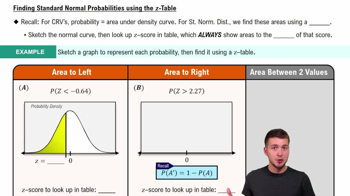
Finding Standard Normal Probabilities using z-Table

Mean and Standard Deviation

The mean is the average value of a data set, while the standard deviation measures the amount of variation or dispersion from the mean. In this scenario, the mean weight of 189 lb and a standard deviation of 39 lb help to understand the typical weight of male passengers and the variability in their weights, which is crucial for assessing safety limits.
Recommended video:
Guided course
08:45
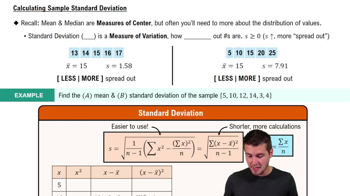
Calculating Standard Deviation

Load Capacity and Safety Assessment

Load capacity refers to the maximum weight a vehicle can safely carry. In this case, the water taxi's load limit of 3500 lb must be evaluated against the potential total weight of 20 male passengers, calculated using the mean and standard deviation. This assessment is essential to determine if the new capacity is safe under worst-case scenarios.
Recommended video:
Guided course
04:40
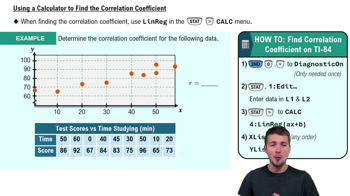
Calculating Correlation Coefficient - Graphing Calculator
Related Practice
Textbook Question

Seat Designs. In Exercises 7–9, assume that when seated, adult males have back-to-knee lengths that are normally distributed with a mean of 23.5 in. and a standard deviation of 1.1 in. (based on anthropometric survey data from Gordon, Churchill, et al.). These data are used often in the design of different seats, including aircraft seats, train seats, theater seats, and classroom seats.


Find the probability that nine males have back-to-knee lengths with a mean greater than 23.0 in.

102
views
Textbook Question

Hershey Kisses Based on Data Set 38 “Candies” in Appendix B, weights of the chocolate in Hershey Kisses are normally distributed with a mean of 4.5338 g and a standard deviation of 0.1039 g


d. What is the value of the variance?

173
views
Textbook Question

Bone Density Test. In Exercises 1–4, assume that scores on a bone mineral density test are normally distributed with a mean of 0 and a standard deviation of 1.


Bone Density For a randomly selected subject, find the probability of a bone density score between and 2.00.

100
views
Textbook Question

Significance For bone density scores that are normally distributed with a mean of 0 and a standard deviation of 1, find the percentage of scores that are


c. not significant (or less than 2 standard deviations away from the mean).

165
views
Textbook Question

Bone Density Test. In Exercises 1–4, assume that scores on a bone mineral density test are normally distributed with a mean of 0 and a standard deviation of 1.


Bone Density Find the bone density score that is the 90th percentile, which is the score separating the lowest 90% from the top 10%.

101
views
Textbook Question

Ergonomics. Exercises 9–16 involve applications to ergonomics, as described in the Chapter Problem.


Doorway Height The Boeing 757-200 ER airliner carries 200 passengers and has doors with a height of 72 in. Heights of men are normally distributed with a mean of 68.6 in. and a standard deviation of 2.8 in. (based on Data Set 1 “Body Data” in Appendix B).


d. When considering the comfort and safety of passengers, why are women ignored in this case?

98
views