Ch. 6 - Normal Probability Distributions
Triola - Elementary Statistics 14th Edition
Triola14th EditionElementary StatisticsISBN: 9780137366446Not the one you use?Change textbook
Chapter 6, Problem 6.C.1.h

In Exercises 1 and 2, use the following wait times (minutes) at 10:00 AM for the Tower of Terror ride at Disney World (from Data Set 33 “Disney World Wait Times” in Appendix B).


35 35 20 50 95 75 45 50 30 35 30 30


h. Are the wait times discrete data or continuous data?

Verified step by step guidance
1
Understand the difference between discrete and continuous data: Discrete data can only take specific values (often integers), while continuous data can take any value within a range.
Consider the nature of the data: Wait times are measured in minutes, which can be counted in whole numbers.
Determine if the data can take on any value within a range or if it is restricted to specific values: Wait times are typically recorded in whole minutes, not fractions of a minute.
Conclude based on the analysis: Since wait times are recorded in whole numbers and cannot take on any value within a range, they are considered discrete data.
Reflect on the implications: Understanding whether data is discrete or continuous helps in choosing appropriate statistical methods for analysis.

Verified video answer for a similar problem:

This video solution was recommended by our tutors as helpful for the problem above.
Video duration:
1m
Was this helpful?

Key Concepts

Here are the essential concepts you must grasp in order to answer the question correctly.

Discrete vs. Continuous Data

Discrete data refers to countable values, often integers, where there are gaps between possible values, such as the number of people or items. Continuous data, on the other hand, can take any value within a range and is often measured, like height or time. In this context, wait times are typically considered continuous because they can be measured to any level of precision, even though they are often rounded to the nearest minute.
Recommended video:
Guided course
04:39
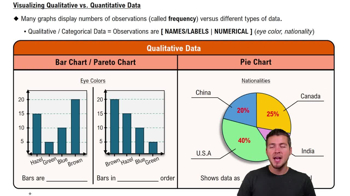
Visualizing Qualitative vs. Quantitative Data

Data Set Analysis

Analyzing a data set involves understanding the type of data, its distribution, and any patterns or anomalies. For the given wait times, one should consider the range, mean, median, and mode to summarize the data effectively. This helps in identifying whether the data is skewed or if there are any outliers, which can influence the interpretation of whether the data is discrete or continuous.
Recommended video:
Guided course
04:39
Visualizing Qualitative vs. Quantitative Data

Measurement Precision

Measurement precision refers to the level of detail in which data is recorded. In the context of wait times, while the data is presented in whole minutes, the underlying concept is continuous because time can be measured in smaller units like seconds or milliseconds. Understanding this distinction is crucial in determining whether data should be treated as discrete or continuous, especially when considering the nature of the measurement process.
Recommended video:
Guided course
04:39
Visualizing Qualitative vs. Quantitative Data
Related Practice
Textbook Question

Standard Normal Distribution. In Exercises 13–16, find the indicated z score. The graph depicts the standard normal distribution of bone density scores with mean 0 and standard deviation 1.


265
views

Textbook Question

Determining Normality. In Exercises 9–12, refer to the indicated sample data and determine whether they appear to be from a population with a normal distribution. Assume that this requirement is loose in the sense that the population distribution need not be exactly normal, but it must be a distribution that is roughly bell-shaped.


Taxi Trips The distances (miles) traveled by New York City taxis transporting customers, as listed in Data Set 32 “Taxis” in Appendix B

163
views
Textbook Question

Basis for the Range Rule of Thumb and the Empirical Rule. In Exercises 45–48, find the indicated area under the curve of the standard normal distribution; then convert it to a percentage and fill in the blank. The results form the basis for the range rule of thumb and the empirical rule introduced in Section 3-2.


About __ % of the area is between z = -3.5 and z = 3.5 (or within 3.5 standard deviation of the mean).

184
views
Textbook Question

Foot Lengths of Women Assume that foot lengths of adult females are normally distributed with a mean of 246.3 mm and a standard deviation of 12.4 mm (based on Data Set 3 “ANSUR II 2012” in Appendix B).


a. Find the probability that a randomly selected adult female has a foot length less than 221.5 mm.

149
views
Textbook Question

Normal Distribution Using a larger data set than the one given for the preceding exercises, assume that cell phone radiation amounts are normally distributed with a mean of 1.17 W/kg and a standard deviation of 0.29 W/kg.

a. Find the probability that a randomly selected cell phone has a radiation amount that exceeds the U.S. standard of 1.6 W/kg or less.

115
views
Textbook Question

Foot Lengths of Women Assume that foot lengths of adult females are normally distributed with a mean of 246.3 mm and a standard deviation of 12.4 mm (based on Data Set 3 “ANSUR II 2012” in Appendix B).


c. Find P95.

115
views