
Ch. 6 - Normal Probability Distributions
Triola - Elementary Statistics 14th Edition
Triola14th EditionElementary StatisticsISBN: 9780137366446Not the one you use?Change textbook
Chapter 6, Problem 6.3.17b

MCAT The Medical College Admissions Test (MCAT) is used to help screen applicants to medical schools. Like many such tests, the MCAT uses multiple-choice questions with each question having five choices, one of which is correct. Assume that you must make random guesses for two such questions. Assume that both questions have correct answers of “a.”


b. Find the mean of the sampling distribution of the sample proportion.

Verified step by step guidance
1
Step 1: Understand the problem. The problem involves finding the mean of the sampling distribution of the sample proportion when guessing answers to two multiple-choice questions, each with five options. The sample proportion refers to the proportion of correct answers in the sample (in this case, two questions).
Step 2: Recall the formula for the mean of the sampling distribution of the sample proportion. The mean is given by \( \mu_{\hat{p}} = p \), where \( p \) is the population proportion of success (the probability of guessing a correct answer).
Step 3: Determine the value of \( p \). Since there are five choices for each question and only one correct answer, the probability of guessing correctly is \( p = \frac{1}{5} \).
Step 4: Substitute the value of \( p \) into the formula for the mean of the sampling distribution. This gives \( \mu_{\hat{p}} = \frac{1}{5} \).
Step 5: Conclude that the mean of the sampling distribution of the sample proportion is equal to the probability of guessing a correct answer, which is \( \frac{1}{5} \).

Verified video answer for a similar problem:

This video solution was recommended by our tutors as helpful for the problem above.
Video duration:
2m
Was this helpful?

Key Concepts

Here are the essential concepts you must grasp in order to answer the question correctly.

Sampling Distribution

A sampling distribution is the probability distribution of a statistic obtained from a larger population, formed by taking multiple samples. In this context, it refers to the distribution of sample proportions derived from random guesses on the MCAT questions. Understanding this concept is crucial for determining how sample proportions behave and vary when drawn from a population.
Recommended video:
05:11
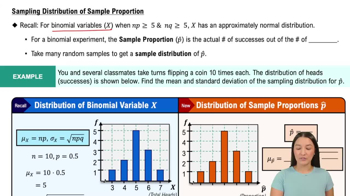
Sampling Distribution of Sample Proportion

Sample Proportion

The sample proportion is the ratio of the number of successes in a sample to the total number of observations in that sample. In the MCAT scenario, if a correct answer is 'a,' the sample proportion would represent the fraction of correct guesses made when answering the questions. This concept is essential for calculating the mean of the sampling distribution.
Recommended video:
05:11
Sampling Distribution of Sample Proportion

Mean of the Sampling Distribution

The mean of the sampling distribution of the sample proportion is the expected value of the sample proportion across all possible samples. It is calculated as the population proportion, which in this case is the probability of guessing the correct answer. For the MCAT questions, if the correct answer is 'a,' the mean would reflect the likelihood of randomly guessing 'a' correctly, providing insight into the overall performance of random guessing.
Recommended video:
05:11
Sampling Distribution of Sample Proportion
Related Practice
Textbook Question

Ergonomics. Exercises 9–16 involve applications to ergonomics, as described in the Chapter Problem.


Safe Loading of Elevators The elevator in the car rental building at San Francisco International Airport has a placard stating that the maximum capacity is “4000 lb—27 passengers.” Because 4000/27=148, this converts to a mean passenger weight of 148 lb when the elevator is full. We will assume a worst-case scenario in which the elevator is filled with 27 adult males. Based on Data Set 1 “Body Data” in Appendix B, assume that adult males have weights that are normally distributed with a mean of 189 lb and a standard deviation of 39 lb.


b. Find the probability that a sample of 27 randomly selected adult males has a mean weight greater than 148 lb.

115
views
Textbook Question

Ergonomics. Exercises 9–16 involve applications to ergonomics, as described in the Chapter Problem.


Water Taxi Safety Passengers died when a water taxi sank in Baltimore’s Inner Harbor. Men are typically heavier than women and children, so when loading a water taxi, assume a worst-case scenario in which all passengers are men. Assume that weights of men are normally distributed with a mean of 189 lb and a standard deviation of 39 lb (based on Data Set 1 “Body Data” in Appendix B). The water taxi that sank had a stated capacity of 25 passengers, and the boat was rated for a load limit of 3500 lb.


b. If the water taxi is filled with 25 randomly selected men, what is the probability that their mean weight exceeds the value from part (a)?

97
views
Textbook Question

In Exercises 7–10, use the same population of {4, 5, 9} that was used in Examples 2 and 5. As in Examples 2 and 5, assume that samples of size n = 2 are randomly selected with replacement.


Sampling Distribution of the Sample Proportion


a. For the population, find the proportion of odd numbers.

144
views
Textbook Question

Hershey Kisses Based on Data Set 38 “Candies” in Appendix B, weights of the chocolate in Hershey Kisses are normally distributed with a mean of 4.5338 g and a standard deviation of 0.1039 g


b. What is the value of the median?

113
views
Textbook Question

Using the Central Limit Theorem. In Exercises 5–8, assume that the amounts of weight that male college students gain during their freshman year are normally distributed with a mean of 1.2 kg and a standard deviation of 4.9 kg (based on Data Set 13 “Freshman 15” in Appendix B).


b. If 9 male college students are randomly selected, find the probability that their mean weight gain during freshman year is between 0 kg and 3 kg.

131
views
Textbook Question

College Presidents There are about 4200 college presidents in the United States, and they have annual incomes with a distribution that is skewed instead of being normal. Many different samples of 40 college presidents are randomly selected, and the mean annual income is computed for each sample.


b. What value do the sample means target? That is, what is the mean of all such sample means?

137
views