For Individual or Group Work (Exercises 147 – 150)In calculus, it is sometimes desirable to rationalize a numerator. To do this, we multiply the numerator and the denominator by the conjugate of the numerator. For example, (6 - √2)/4 = (6 - √2)/4 × (6 + √2)/(6 + √2) = (36 - 2)/(4(6 + √2)) = 34/(4(6 + √2)) = 17/(2(6 + √2)) = 17/(6 + √2). 2√10 + √7 30
Verified step by step guidance
1
Identify the expression to rationalize: the numerator is \(2\sqrt{10} + \sqrt{7}\) and the denominator is 30.
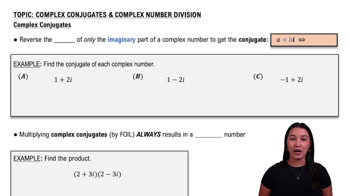
To rationalize the numerator, multiply both the numerator and the denominator by the conjugate of the numerator. The conjugate of \(2\sqrt{10} + \sqrt{7}\) is \(2\sqrt{10} - \sqrt{7}\).
Set up the multiplication: multiply numerator and denominator by \(2\sqrt{10} - \sqrt{7}\), so the expression becomes \(\frac{(2\sqrt{10} + \sqrt{7})(2\sqrt{10} - \sqrt{7})}{30(2\sqrt{10} - \sqrt{7})}\).
Use the difference of squares formula for the numerator: \((a + b)(a - b) = a^2 - b^2\). Here, \(a = 2\sqrt{10}\) and \(b = \sqrt{7}\), so calculate \(a^2 - b^2\).
Simplify the numerator by squaring each term: \(a^2 = (2\sqrt{10})^2\) and \(b^2 = (\sqrt{7})^2\), then subtract to get the rationalized numerator. The denominator remains as \(30(2\sqrt{10} - \sqrt{7})\).
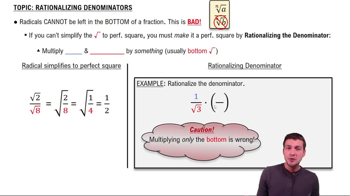
Verified video answer for a similar problem:
This video solution was recommended by our tutors as helpful for the problem above
Video duration:
6m
Play a video:
0 Comments
Key Concepts
Here are the essential concepts you must grasp in order to answer the question correctly.
Rationalizing the Numerator
Rationalizing the numerator involves eliminating radicals from the numerator of a fraction by multiplying both numerator and denominator by a suitable expression, often the conjugate. This process simplifies expressions and makes them easier to work with, especially in calculus and algebra.
The conjugate of a binomial expression a + b√c is a - b√c, and vice versa. Multiplying an expression by its conjugate uses the difference of squares formula, which removes the square root terms, resulting in a rational number or simpler expression.
The difference of squares formula states that (x + y)(x - y) = x² - y². This identity is crucial when multiplying conjugates because it eliminates radicals by turning the product into the difference of two squares, simplifying expressions with square roots.

 6:14 minutes
 Verified step by step guidance
 2:58
2:58