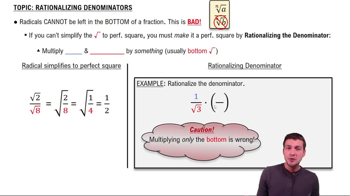
For Individual or Group Work (Exercises 147 – 150)In calculus, it is sometimes desirable to rationalize a numerator. To do this, we multiply the numerator and the denominator by the conjugate of the numerator. For example, (6 - √2)/4 = (6 - √2)/4 × (6 + √2)/(6 + √2) = (36 - 2)/(4(6 + √2)) = 34/(4(6 + √2)) = 17/(2(6 + √2)) = 17/(6 + √2). Rationalize each numerator. (6 - √3)/8
Verified step by step guidance
1
Identify the expression to rationalize: \(\frac{6 - \sqrt{3}}{8}\). The numerator is \(6 - \sqrt{3}\), which contains a square root that we want to eliminate by rationalizing.
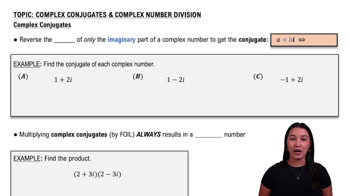
Find the conjugate of the numerator. The conjugate of \(6 - \sqrt{3}\) is \(6 + \sqrt{3}\). This is because conjugates have the same terms but opposite signs between them.
Multiply both the numerator and the denominator by the conjugate of the numerator to keep the expression equivalent. This gives: \(\frac{6 - \sqrt{3}}{8} \times \frac{6 + \sqrt{3}}{6 + \sqrt{3}}\).
Use the difference of squares formula to simplify the numerator: \((a - b)(a + b) = a^2 - b^2\). Here, \(a = 6\) and \(b = \sqrt{3}\), so the numerator becomes \(6^2 - (\sqrt{3})^2\).
Simplify the numerator and write the new expression as \(\frac{36 - 3}{8(6 + \sqrt{3})}\). This is the rationalized form with the numerator free of square roots.
Verified video answer for a similar problem:
This video solution was recommended by our tutors as helpful for the problem above
Video duration:
4m
Play a video:
0 Comments
Key Concepts
Here are the essential concepts you must grasp in order to answer the question correctly.
Rationalizing the Numerator
Rationalizing the numerator involves eliminating any irrational numbers (like square roots) from the numerator of a fraction. This is done by multiplying both numerator and denominator by the conjugate of the numerator, which helps simplify expressions and makes further calculations easier.
The conjugate of a binomial expression a + √b is a - √b, and vice versa. Multiplying conjugates results in a difference of squares, which removes the square root terms. This property is essential for rationalizing expressions containing radicals.
The difference of squares formula states that (x + y)(x - y) = x² - y². When applied to conjugates involving square roots, it eliminates the radical by converting it into a rational number, simplifying the expression significantly.

 4:03 minutes
 Verified step by step guidance
 2:58
2:58