Determine the amplitude of each function. Then graph the function and y = sin x in the same rectangular coordinate system for 0 ≤ x ≤ 2π. y = 1/3 sin x
Table of contents
- 0. Review of College Algebra4h 45m
- 1. Measuring Angles40m
- 2. Trigonometric Functions on Right Triangles2h 5m
- 3. Unit Circle1h 19m
- 4. Graphing Trigonometric Functions1h 19m
- 5. Inverse Trigonometric Functions and Basic Trigonometric Equations1h 41m
- 6. Trigonometric Identities and More Equations2h 34m
- 7. Non-Right Triangles1h 38m
- 8. Vectors2h 25m
- 9. Polar Equations2h 5m
- 10. Parametric Equations1h 6m
- 11. Graphing Complex Numbers1h 7m
4. Graphing Trigonometric Functions
Graphs of the Sine and Cosine Functions
Problem 11
Textbook Question
Match each function with its graph in choices A–I. (One choice will not be used.)
y = cos (x - π/4)
A. <IMAGE> B. <IMAGE> C. <IMAGE>
D. <IMAGE> E. <IMAGE> F. <IMAGE>
G. <IMAGE> H. <IMAGE> I. <IMAGE>
Verified step by step guidance1
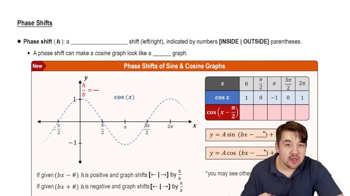
Understand that the function given is \(y = \cos\left(x - \frac{\pi}{4}\right)\), which represents a horizontal shift of the basic cosine function \(y = \cos x\) to the right by \(\frac{\pi}{4}\) units.
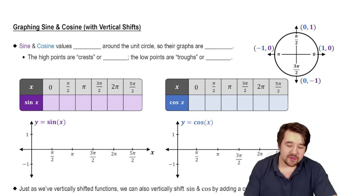
Recall the key features of the cosine graph: it has a maximum value of 1 at \(x=0\), crosses zero at \(x=\frac{\pi}{2}\), reaches a minimum of -1 at \(x=\pi\), and completes one full period at \(x=2\pi\).
Apply the horizontal shift to these key points by adding \(\frac{\pi}{4}\) to each x-coordinate, so the maximum now occurs at \(x=\frac{\pi}{4}\), the zero crossing at \(x=\frac{3\pi}{4}\), the minimum at \(x=\pi + \frac{\pi}{4} = \frac{5\pi}{4}\), and so on.
Examine each graph choice (A through I) and identify which one shows a cosine wave shifted to the right by \(\frac{\pi}{4}\), matching the shifted key points and shape of the cosine function.
Select the graph that matches these characteristics, and note that one graph will not correspond to any function given, so it will remain unused.
Verified video answer for a similar problem:This video solution was recommended by our tutors as helpful for the problem above
Play a video:
0 Comments
Key Concepts
Here are the essential concepts you must grasp in order to answer the question correctly.
Phase Shift in Trigonometric Functions
Phase shift refers to the horizontal translation of a trigonometric graph caused by adding or subtracting a constant inside the function's argument. For y = cos(x - π/4), the graph shifts π/4 units to the right compared to y = cos(x). Understanding phase shifts helps identify how the graph moves along the x-axis.
Recommended video:
Phase Shifts
Basic Shape and Properties of the Cosine Function
The cosine function is periodic with period 2π, oscillating between -1 and 1, starting at a maximum value of 1 when x = 0. Recognizing its characteristic wave shape and key points (maxima, minima, zeros) is essential for matching the function to its graph.
Recommended video:
Graph of Sine and Cosine Function
Graph Matching Techniques for Trigonometric Functions
Matching a trigonometric function to its graph involves analyzing shifts, amplitude, period, and key points. By comparing these features with given graphs, one can identify the correct match and exclude incorrect options, especially when one choice remains unused.
Recommended video:
Introduction to Trigonometric Functions
Related Videos
Related Practice
Textbook Question
831
views