Find the exact value of each expression. cos⁻¹ (-√2/2)
Verified step by step guidance
1
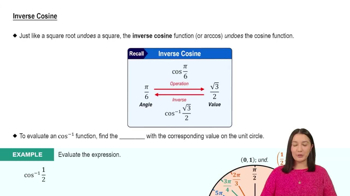
Recognize that the expression involves the inverse cosine function, written as \(\cos^{-1}(x)\), which gives the angle whose cosine is \(x\).
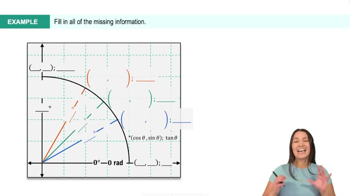
Identify the value inside the inverse cosine: \(-\frac{\sqrt{2}}{2}\). Recall that \(\cos(\theta) = -\frac{\sqrt{2}}{2}\) corresponds to specific angles on the unit circle.
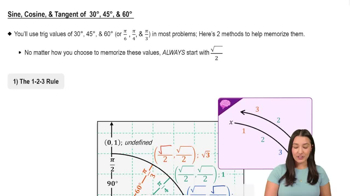
Recall the reference angle where \(\cos(\theta) = \frac{\sqrt{2}}{2}\), which is \(\frac{\pi}{4}\) radians (or 45 degrees). Since the cosine is negative, the angle must be in either the second or third quadrant.
Since the range of \(\cos^{-1}(x)\) is \([0, \pi]\), the angle must be in the second quadrant. Therefore, the angle is \(\pi - \frac{\pi}{4}\).
Express the exact value of \(\cos^{-1} \left(-\frac{\sqrt{2}}{2}\right)\) as \(\pi - \frac{\pi}{4}\), which can be simplified further if needed.
Verified video answer for a similar problem:
This video solution was recommended by our tutors as helpful for the problem above
Video duration:
4m
Play a video:
0 Comments
Key Concepts
Here are the essential concepts you must grasp in order to answer the question correctly.
Inverse Cosine Function (cos⁻¹)
The inverse cosine function, denoted as cos⁻¹ or arccos, returns the angle whose cosine is a given value. Its range is limited to [0, π] radians (or [0°, 180°]) to ensure it is a function. Understanding this helps find the angle corresponding to a specific cosine value.
Certain angles have well-known cosine values involving square roots, such as cos(45°) = √2/2. Recognizing these exact values allows you to identify angles without a calculator, which is essential for finding precise inverse trigonometric values.
Cosine values can be negative depending on the quadrant of the angle. Since cos⁻¹ outputs angles in [0, π], negative cosine values correspond to angles in the second quadrant (between 90° and 180°). This knowledge helps determine the correct angle for negative inputs.

 4:10 minutes
 Verified step by step guidance
 4:49
4:49