Find the exact value of each expression. cos⁻¹ √3/2
Verified step by step guidance
1
Recognize that the expression involves the inverse cosine function, written as \(\cos^{-1}\), which means we are looking for an angle whose cosine value is given.
Identify the value inside the inverse cosine function: \(\sqrt{3}/2\). Recall that \(\sqrt{3}/2\) is a common cosine value for special angles in the unit circle.
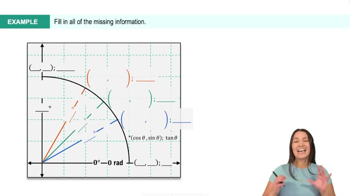
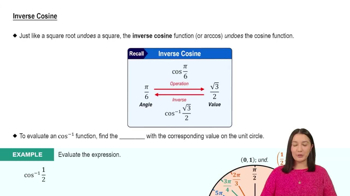
Recall the unit circle values for cosine: \(\cos 30^\circ = \cos \frac{\pi}{6} = \sqrt{3}/2\). This means the angle we are looking for is \(\frac{\pi}{6}\) radians (or 30 degrees).
Since the range of \(\cos^{-1}\) is \([0, \pi]\), the principal value of \(\cos^{-1} \left( \sqrt{3}/2 \right)\) is \(\frac{\pi}{6}\).
Therefore, the exact value of \(\cos^{-1} \left( \sqrt{3}/2 \right)\) is the angle \(\frac{\pi}{6}\) radians.
Verified video answer for a similar problem:
This video solution was recommended by our tutors as helpful for the problem above
Video duration:
4m
Play a video:
0 Comments
Key Concepts
Here are the essential concepts you must grasp in order to answer the question correctly.
Inverse Cosine Function (cos⁻¹ or arccos)
The inverse cosine function, denoted as cos⁻¹ or arccos, returns the angle whose cosine value is a given number. It is defined for inputs between -1 and 1 and outputs angles in the range 0 to π radians (0° to 180°). Understanding this function is essential to find the angle corresponding to a specific cosine value.
Certain angles have well-known cosine values expressed in exact radical form, such as cos(30°) = √3/2. Recognizing these special angles allows you to determine the exact angle from a given cosine value without using a calculator, which is crucial for solving inverse trigonometric problems.
Domain and Range Restrictions of Inverse Trigonometric Functions
Inverse trigonometric functions have specific domain and range restrictions to ensure they are functions. For arccos, the input must be between -1 and 1, and the output angle lies between 0 and π radians. Knowing these restrictions helps identify the correct angle solution when evaluating inverse cosine expressions.

 4:35 minutes
 Verified step by step guidance
 4:49
4:49