Find the exact values of s in the given interval that satisfy the given condition.
[0 , 2π) ; cos² s = 1/2
Verified step by step guidance
1
Start with the given equation: \(\cos^{2} s = \frac{1}{2}\).
Take the square root of both sides to solve for \(\cos s\): \(\cos s = \pm \sqrt{\frac{1}{2}}\).
Simplify the square root: \(\cos s = \pm \frac{\sqrt{2}}{2}\).
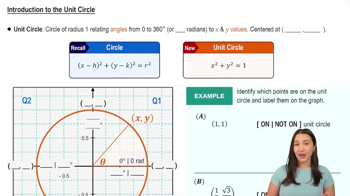
Recall the unit circle values where \(\cos s = \pm \frac{\sqrt{2}}{2}\), which correspond to angles \(s = \frac{\pi}{4}, \frac{3\pi}{4}, \frac{5\pi}{4}, \frac{7\pi}{4}\) within the interval \([0, 2\pi)\).
List these values as the exact solutions for \(s\) in the given interval.
Verified video answer for a similar problem:
This video solution was recommended by our tutors as helpful for the problem above
Play a video:
0 Comments
Key Concepts
Here are the essential concepts you must grasp in order to answer the question correctly.
Trigonometric Functions and Their Squares
The cosine function, cos(s), measures the horizontal coordinate of a point on the unit circle at angle s. Squaring the cosine, cos²(s), means taking the square of this value, which is always non-negative and ranges from 0 to 1. Understanding how cos²(s) relates to cos(s) is essential for solving equations involving squared trigonometric functions.
The unit circle represents all angles s from 0 to 2π radians, corresponding to one full rotation. Knowing how cosine values correspond to points on the unit circle helps identify all angles s within the interval [0, 2π) that satisfy the equation. This includes recognizing symmetry and periodicity of cosine.
To solve equations like cos²(s) = 1/2, one must first find cos(s) = ±√(1/2) = ±√2/2. Then, determine all angles s in the given interval where cosine equals these values. This involves using inverse cosine functions and considering all solutions within the specified domain.

 Verified step by step guidance
 6:04
6:04