Find the exact value of s in the given interval that has the given circular function value.
[π, 3π/2] ; tan s = √3
Verified step by step guidance
1
Identify the given interval for the variable \(s\), which is \([\pi, \frac{3\pi}{2}]\). This means \(s\) lies between \(\pi\) and \(\frac{3\pi}{2}\) radians, or between 180° and 270°.
Recall that \(\tan s = \sqrt{3}\). We need to find the angle(s) \(s\) within the given interval where the tangent function equals \(\sqrt{3}\).
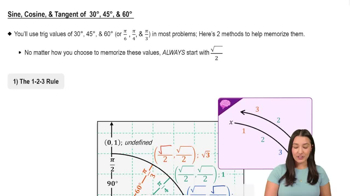
Remember the reference angle where \(\tan \theta = \sqrt{3}\) is \(\theta = \frac{\pi}{3}\) (or 60°). Tangent is positive in the first and third quadrants.
Since the interval \([\pi, \frac{3\pi}{2}]\) corresponds to the third quadrant, and tangent is positive there, the solution will be \(s = \pi + \frac{\pi}{3}\).
Write the exact value of \(s\) as \(s = \pi + \frac{\pi}{3} = \frac{4\pi}{3}\). This is the angle in the given interval where \(\tan s = \sqrt{3}\).
Verified video answer for a similar problem:
This video solution was recommended by our tutors as helpful for the problem above
Play a video:
0 Comments
Key Concepts
Here are the essential concepts you must grasp in order to answer the question correctly.
Unit Circle and Angle Intervals
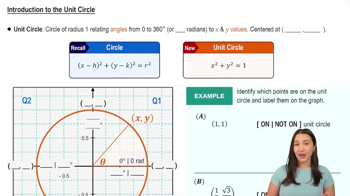
The unit circle represents angles and their corresponding trigonometric values on a circle of radius 1. Understanding the interval [π, 3π/2] means focusing on the third quadrant, where angles range from 180° to 270°, which affects the sign and values of trigonometric functions.
The tangent of an angle is the ratio of the sine to the cosine of that angle (tan θ = sin θ / cos θ). Knowing common exact values, such as tan(π/3) = √3, helps identify possible angles that satisfy the equation tan s = √3.
The sign of tangent depends on the signs of sine and cosine in each quadrant. In the third quadrant, both sine and cosine are negative, making tangent positive. This knowledge helps confirm that tan s = √3 is possible in [π, 3π/2] and guides finding the exact angle.