In Exercises 35–38, find the exact value of the following under the given conditions: d. sin 2α sin α = -1/3, 𝝅 < α < 3𝝅/2, and cos β = -1/3, 𝝅 < β < 3𝝅/2.
Verified step by step guidance
1
Identify the given information: \( \sin \alpha = -\frac{1}{3} \) with \( \pi < \alpha < \frac{3\pi}{2} \), and \( \cos \beta = -\frac{1}{3} \) with \( \pi < \beta < \frac{3\pi}{2} \). Note that both angles are in the third quadrant where sine and cosine are negative.
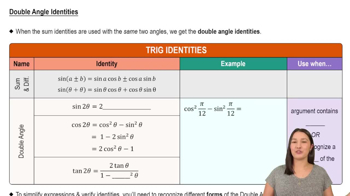
Recall the double-angle identity for sine: \( \sin 2\alpha = 2 \sin \alpha \cos \alpha \). To find \( \sin 2\alpha \), we need \( \cos \alpha \) as well as \( \sin \alpha \).
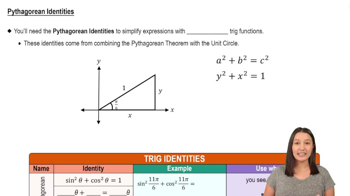
Use the Pythagorean identity to find \( \cos \alpha \): \( \cos^2 \alpha = 1 - \sin^2 \alpha \). Substitute \( \sin \alpha = -\frac{1}{3} \) to get \( \cos^2 \alpha = 1 - \left(-\frac{1}{3}\right)^2 = 1 - \frac{1}{9} = \frac{8}{9} \).
Determine the sign of \( \cos \alpha \) based on the quadrant. Since \( \alpha \) is in the third quadrant, \( \cos \alpha \) is negative, so \( \cos \alpha = -\sqrt{\frac{8}{9}} = -\frac{2\sqrt{2}}{3} \).
Substitute \( \sin \alpha \) and \( \cos \alpha \) into the double-angle formula: \( \sin 2\alpha = 2 \times \left(-\frac{1}{3}\right) \times \left(-\frac{2\sqrt{2}}{3}\right) \). Simplify this expression to find the exact value of \( \sin 2\alpha \).
Verified video answer for a similar problem:
This video solution was recommended by our tutors as helpful for the problem above
Video duration:
6m
Play a video:
0 Comments
Key Concepts
Here are the essential concepts you must grasp in order to answer the question correctly.
Double-Angle Identity for Sine
The double-angle identity for sine states that sin(2α) = 2 sin(α) cos(α). This formula allows you to find the sine of twice an angle using the sine and cosine of the original angle, which is essential when given sin(α) and needing sin(2α).
Determining the Sign of Trigonometric Functions Based on Quadrants
The sign of sine and cosine depends on the quadrant in which the angle lies. For example, if π < α < 3π/2 (third quadrant), both sine and cosine are negative. Knowing the quadrant helps determine the correct sign of cosine or sine when only one value is given.
Using the Pythagorean Identity to Find Missing Trigonometric Values
The Pythagorean identity, sin²(θ) + cos²(θ) = 1, allows you to find the missing sine or cosine value when one is known. By rearranging, cos(θ) = ±√(1 - sin²(θ)), and the sign is chosen based on the quadrant of θ.