Use one or more of the six sum and difference identities to solve Exercises 13–54. In Exercises 13–24, find the exact value of each expression. tan ( 5𝝅/3 ﹣ 𝝅/4)
Table of contents
- 0. Review of College Algebra4h 45m
- 1. Measuring Angles40m
- 2. Trigonometric Functions on Right Triangles2h 5m
- 3. Unit Circle1h 19m
- 4. Graphing Trigonometric Functions1h 19m
- 5. Inverse Trigonometric Functions and Basic Trigonometric Equations1h 41m
- 6. Trigonometric Identities and More Equations2h 34m
- 7. Non-Right Triangles1h 38m
- 8. Vectors2h 25m
- 9. Polar Equations2h 5m
- 10. Parametric Equations1h 6m
- 11. Graphing Complex Numbers1h 7m
6. Trigonometric Identities and More Equations
Sum and Difference Identities
Problem 3.RE.35a
Textbook Question
In Exercises 35–38, find the exact value of the following under the given conditions:
a. sin(α + β)
sin α = 3/5, 0 < α < 𝝅/2, and sin β = 12/13, 𝝅/2 < β < 𝝅.
Verified step by step guidance1
Identify the given information: \( \sin \alpha = \frac{3}{5} \) with \( 0 < \alpha < \frac{\pi}{2} \), and \( \sin \beta = \frac{12}{13} \) with \( \frac{\pi}{2} < \beta < \pi \).
Determine the quadrants for \( \alpha \) and \( \beta \) to find the signs of \( \cos \alpha \) and \( \cos \beta \). Since \( \alpha \) is in the first quadrant, \( \cos \alpha > 0 \). Since \( \beta \) is in the second quadrant, \( \cos \beta < 0 \).
Use the Pythagorean identity to find \( \cos \alpha \) and \( \cos \beta \):
\[ \cos \theta = \pm \sqrt{1 - \sin^2 \theta} \]
Calculate:
\[ \cos \alpha = +\sqrt{1 - \left(\frac{3}{5}\right)^2} \]
\[ \cos \beta = -\sqrt{1 - \left(\frac{12}{13}\right)^2} \]
Apply the sine addition formula:
\[ \sin(\alpha + \beta) = \sin \alpha \cos \beta + \cos \alpha \sin \beta \]
Substitute the known values of \( \sin \alpha \), \( \cos \alpha \), \( \sin \beta \), and \( \cos \beta \) into the formula to express \( \sin(\alpha + \beta) \) exactly.
Verified video answer for a similar problem:This video solution was recommended by our tutors as helpful for the problem above
Video duration:
5mPlay a video:
0 Comments
Key Concepts
Here are the essential concepts you must grasp in order to answer the question correctly.
Sum of Angles Formula for Sine
The sum of angles formula states that sin(α + β) = sin α cos β + cos α sin β. This identity allows us to find the sine of a sum of two angles using the sine and cosine of each individual angle, which is essential for solving the problem.
Recommended video:
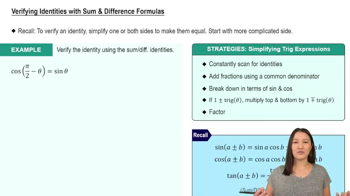
Verifying Identities with Sum and Difference Formulas
Determining Cosine from Sine and Quadrant
Given sin θ and the quadrant of angle θ, we can find cos θ using the Pythagorean identity cos² θ = 1 - sin² θ. The sign of cos θ depends on the quadrant, so knowing the angle's range is crucial to assign the correct positive or negative value.
Recommended video:
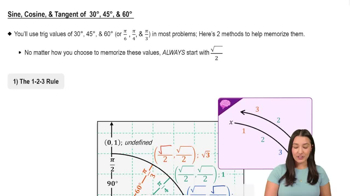
Sine, Cosine, & Tangent of 30°, 45°, & 60°
Understanding Angle Ranges and Quadrants
The given angle ranges (e.g., 0 < α < π/2) indicate the quadrant in which each angle lies. This information helps determine the signs of sine and cosine values, which is necessary for correctly applying trigonometric identities and finding exact values.
Recommended video:
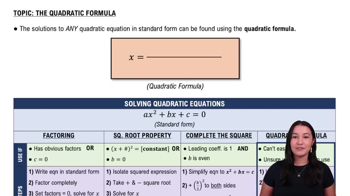
Quadratic Formula
Related Videos
Related Practice
Textbook Question
748
views