CONCEPT PREVIEW Fill in the blank to correctly complete each sentence. One degree, written 1°, represents ____________ of a complete rotation.
Table of contents
- 0. Review of College Algebra4h 45m
- 1. Measuring Angles40m
- 2. Trigonometric Functions on Right Triangles2h 5m
- 3. Unit Circle1h 19m
- 4. Graphing Trigonometric Functions1h 19m
- 5. Inverse Trigonometric Functions and Basic Trigonometric Equations1h 41m
- 6. Trigonometric Identities and More Equations2h 34m
- 7. Non-Right Triangles1h 38m
- 8. Vectors2h 25m
- 9. Polar Equations2h 5m
- 10. Parametric Equations1h 6m
- 11. Graphing Complex Numbers1h 7m
1. Measuring Angles
Angles in Standard Position
Problem 35
Textbook Question
Find the measure of the smaller angle formed by the hands of a clock at the following times. 3:15
Verified step by step guidance1
Understand that the problem asks for the smaller angle between the hour and minute hands of a clock at 3:15.
Calculate the position of the minute hand: since the minute hand moves 360 degrees in 60 minutes, its angle from the 12 o'clock position is given by \(\text{Minute Angle} = 6 \times \text{minutes}\). For 15 minutes, this is \(6 \times 15\) degrees.
Calculate the position of the hour hand: the hour hand moves 360 degrees in 12 hours, so it moves 30 degrees per hour. Additionally, it moves 0.5 degrees per minute. The formula for the hour hand angle is \(\text{Hour Angle} = 30 \times \text{hours} + 0.5 \times \text{minutes}\). For 3:15, substitute hours = 3 and minutes = 15.
Find the difference between the two angles calculated: \(\text{Angle Difference} = |\text{Hour Angle} - \text{Minute Angle}|\).
Since the clock is circular, the smaller angle between the hands is the minimum of \(\text{Angle Difference}\) and \(360 - \text{Angle Difference}\). This gives the measure of the smaller angle formed at 3:15.
Verified video answer for a similar problem:This video solution was recommended by our tutors as helpful for the problem above
Video duration:
4mPlay a video:
0 Comments
Key Concepts
Here are the essential concepts you must grasp in order to answer the question correctly.
Angle Measurement of Clock Hands
The position of clock hands can be translated into angles measured from the 12 o'clock position. The minute hand moves 6 degrees per minute (360°/60), while the hour hand moves 0.5 degrees per minute (30° per hour). Understanding these rates is essential to calculate the exact angles at any given time.
Recommended video:
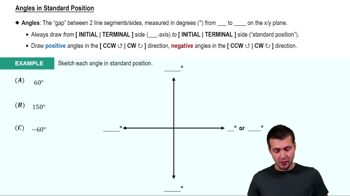
Drawing Angles in Standard Position
Calculating the Angle Between Two Lines
The angle between two clock hands is found by taking the absolute difference of their individual angles from the 12 o'clock position. Since the clock is circular, if this difference exceeds 180 degrees, the smaller angle is found by subtracting it from 360 degrees.
Recommended video:
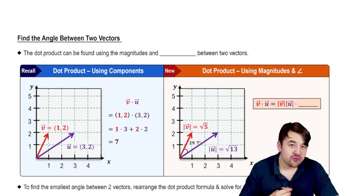
Find the Angle Between Vectors
Time to Angle Conversion for the Hour Hand
Unlike the minute hand, the hour hand moves continuously as time passes. At 3:15, the hour hand is not exactly at 3 but has moved a quarter of the way towards 4. This continuous movement is calculated by adding 0.5 degrees per minute to the base hour angle.
Recommended video:
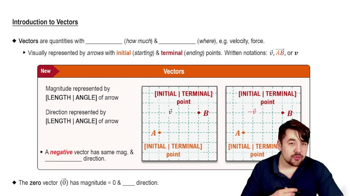
Introduction to Vectors
Related Videos
Related Practice
Textbook Question
610
views