In Exercises 59–62, use a calculator to find the value of the acute angle θ in radians, rounded to three decimal places. cos θ = 0.4112
Table of contents
- 0. Review of College Algebra4h 45m
- 1. Measuring Angles40m
- 2. Trigonometric Functions on Right Triangles2h 5m
- 3. Unit Circle1h 19m
- 4. Graphing Trigonometric Functions1h 19m
- 5. Inverse Trigonometric Functions and Basic Trigonometric Equations1h 41m
- 6. Trigonometric Identities and More Equations2h 34m
- 7. Non-Right Triangles1h 38m
- 8. Vectors2h 25m
- 9. Polar Equations2h 5m
- 10. Parametric Equations1h 6m
- 11. Graphing Complex Numbers1h 7m
1. Measuring Angles
Angles in Standard Position
Problem 1
Textbook Question
CONCEPT PREVIEW Fill in the blank to correctly complete each sentence. One degree, written 1°, represents ____________ of a complete rotation.
Verified step by step guidance1
Understand that a complete rotation corresponds to 360 degrees, which means 360° represents one full turn around a circle.
Recognize that the problem asks for the fraction of a complete rotation that one degree (1°) represents.
Express the fraction as the ratio of one degree to the total degrees in a full rotation: \(\frac{1}{360}\).
Interpret this fraction as one degree being one three-hundred-sixtieth of a full rotation.
Therefore, complete the sentence by stating that 1° represents \(\frac{1}{360}\) of a complete rotation.
Verified video answer for a similar problem:This video solution was recommended by our tutors as helpful for the problem above
Video duration:
1mPlay a video:
0 Comments
Key Concepts
Here are the essential concepts you must grasp in order to answer the question correctly.
Degree as a Unit of Angle Measurement
A degree (°) is a unit used to measure angles, representing a fraction of a full rotation. One complete rotation around a point is divided into 360 equal parts, each called one degree.
Recommended video:
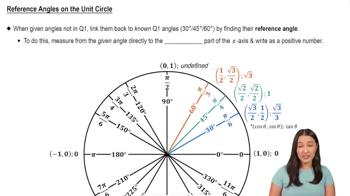
Reference Angles on the Unit Circle
Full Rotation in Degrees
A full rotation corresponds to 360 degrees, meaning that an angle of 360° represents one complete turn around a circle or point.
Recommended video:
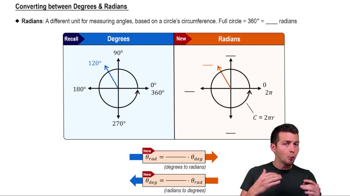
Converting between Degrees & Radians
Fractional Representation of Angles
Angles can be expressed as fractions of a full rotation; for example, 1° is 1/360 of a complete rotation, showing how degrees quantify parts of a circle.
Recommended video:
Solving Linear Equations with Fractions
Related Videos
Related Practice
Textbook Question
613
views