Determine whether each statement is true or false. See Example 4. cot 30° < tan 40°
Table of contents
- 0. Review of College Algebra4h 45m
- 1. Measuring Angles40m
- 2. Trigonometric Functions on Right Triangles2h 5m
- 3. Unit Circle1h 19m
- 4. Graphing Trigonometric Functions1h 19m
- 5. Inverse Trigonometric Functions and Basic Trigonometric Equations1h 41m
- 6. Trigonometric Identities and More Equations2h 34m
- 7. Non-Right Triangles1h 38m
- 8. Vectors2h 25m
- 9. Polar Equations2h 5m
- 10. Parametric Equations1h 6m
- 11. Graphing Complex Numbers1h 7m
3. Unit Circle
Defining the Unit Circle
Problem 7
Textbook Question
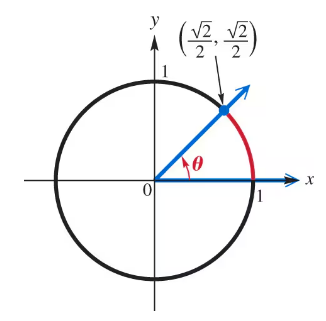
Each figure shows an angle θ in standard position with its terminal side intersecting the unit circle. Evaluate the six circular function values of θ.

Verified step by step guidance1
Identify the coordinates of the point where the terminal side of the angle \( \theta \) intersects the unit circle. Since the circle has radius 1, these coordinates are \( (x, y) \) with \( x^2 + y^2 = 1 \).
Recall the definitions of the six circular (trigonometric) functions in terms of \( x \) and \( y \) on the unit circle:
- \( \sin(\theta) = y \)
- \( \cos(\theta) = x \)
- \( \tan(\theta) = \frac{y}{x} \) (provided \( x \neq 0 \))
- \( \csc(\theta) = \frac{1}{y} \) (provided \( y \neq 0 \))
- \( \sec(\theta) = \frac{1}{x} \) (provided \( x \neq 0 \))
- \( \cot(\theta) = \frac{x}{y} \) (provided \( y \neq 0 \))
Substitute the \( x \) and \( y \) values from the point on the unit circle into each of the six function formulas to find their values.
Check the quadrant in which the terminal side of \( \theta \) lies to determine the signs (positive or negative) of each function value, since the signs depend on the quadrant.
Write down the six values clearly, ensuring to note any undefined functions if division by zero occurs (for example, if \( x = 0 \) or \( y = 0 \)).
Verified video answer for a similar problem:This video solution was recommended by our tutors as helpful for the problem above
Play a video:
0 Comments
Key Concepts
Here are the essential concepts you must grasp in order to answer the question correctly.
Unit Circle and Standard Position
The unit circle is a circle with radius 1 centered at the origin of the coordinate plane. An angle in standard position has its vertex at the origin and its initial side along the positive x-axis. The terminal side intersects the unit circle at a point whose coordinates correspond to cosine and sine values of the angle.
Recommended video:
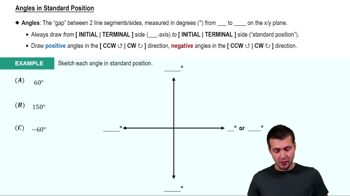
Drawing Angles in Standard Position
Circular Functions (Trigonometric Functions)
The six circular functions are sine, cosine, tangent, cosecant, secant, and cotangent. For an angle θ on the unit circle, sine and cosine are the y- and x-coordinates of the intersection point, respectively. Tangent is sine divided by cosine, while cosecant, secant, and cotangent are their respective reciprocals.
Recommended video:
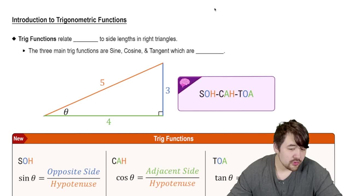
Introduction to Trigonometric Functions
Evaluating Trigonometric Functions from Coordinates
To find the six circular function values, use the coordinates (x, y) of the terminal side's intersection with the unit circle: sin(θ) = y, cos(θ) = x, tan(θ) = y/x. The reciprocal functions are csc(θ) = 1/y, sec(θ) = 1/x, and cot(θ) = x/y, provided the denominators are not zero.
Recommended video:
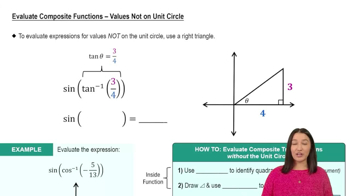
Evaluate Composite Functions - Values Not on Unit Circle
Related Videos
Related Practice
Textbook Question
601
views
