Find the magnitude and direction angle for each vector. Round angle measures to the nearest tenth, as necessary. 〈-4, 4√3〉
Verified step by step guidance
1
Identify the components of the vector. Here, the vector is given as \(\langle -4, 4\sqrt{3} \rangle\), where the \(x\)-component is \(-4\) and the \(y\)-component is \(4\sqrt{3}\).
Calculate the magnitude of the vector using the formula \(\text{magnitude} = \sqrt{x^2 + y^2}\). Substitute the values to get \(\sqrt{(-4)^2 + (4\sqrt{3})^2}\).
Simplify the expression inside the square root by squaring each component: \((-4)^2 = 16\) and \((4\sqrt{3})^2 = 16 \times 3 = 48\). Then add these results.
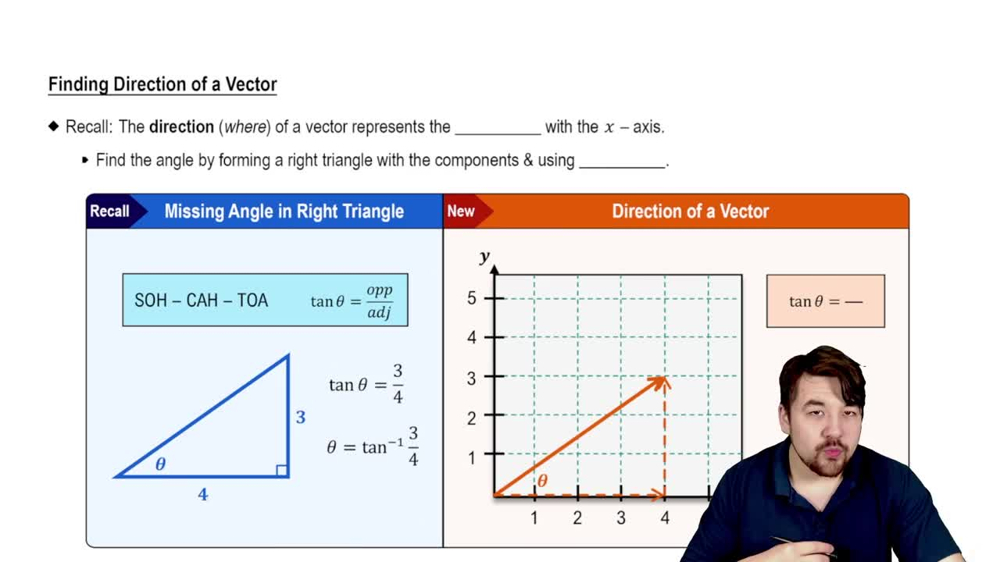
Find the direction angle \(\theta\) of the vector relative to the positive \(x\)-axis using the formula \(\theta = \tan^{-1}\left(\frac{y}{x}\right)\). Substitute the components to get \(\theta = \tan^{-1}\left(\frac{4\sqrt{3}}{-4}\right)\).
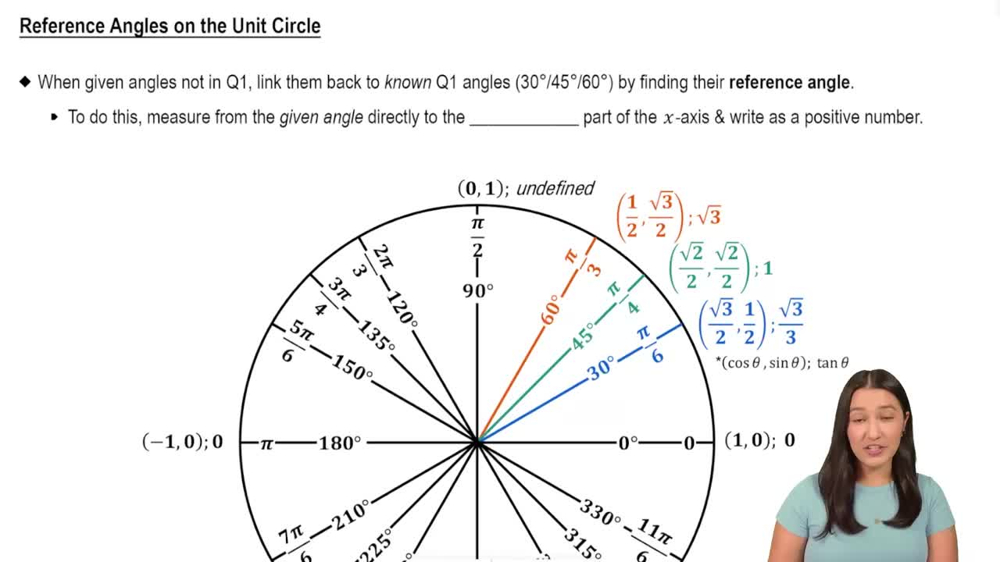
Since the \(x\)-component is negative and the \(y\)-component is positive, the vector lies in the second quadrant. Adjust the angle accordingly by adding \(180^\circ\) if necessary, and round the angle to the nearest tenth of a degree.
Verified video answer for a similar problem:
This video solution was recommended by our tutors as helpful for the problem above
Play a video:
0 Comments
Key Concepts
Here are the essential concepts you must grasp in order to answer the question correctly.
Vector Components and Magnitude
A vector in two dimensions can be represented by its components along the x and y axes. The magnitude (length) of the vector is found using the Pythagorean theorem: the square root of the sum of the squares of its components. For example, for vector 〈x, y〉, magnitude = √(x² + y²).
The direction angle of a vector is the angle it makes with the positive x-axis, measured counterclockwise. It can be found using the inverse tangent function: θ = arctan(y/x). Care must be taken to consider the signs of x and y to determine the correct quadrant for the angle.
When calculating angles, results are often rounded to a specified precision, such as the nearest tenth of a degree. Angles are typically expressed in degrees for practical applications, and rounding ensures clarity and consistency in communication.

 Verified step by step guidance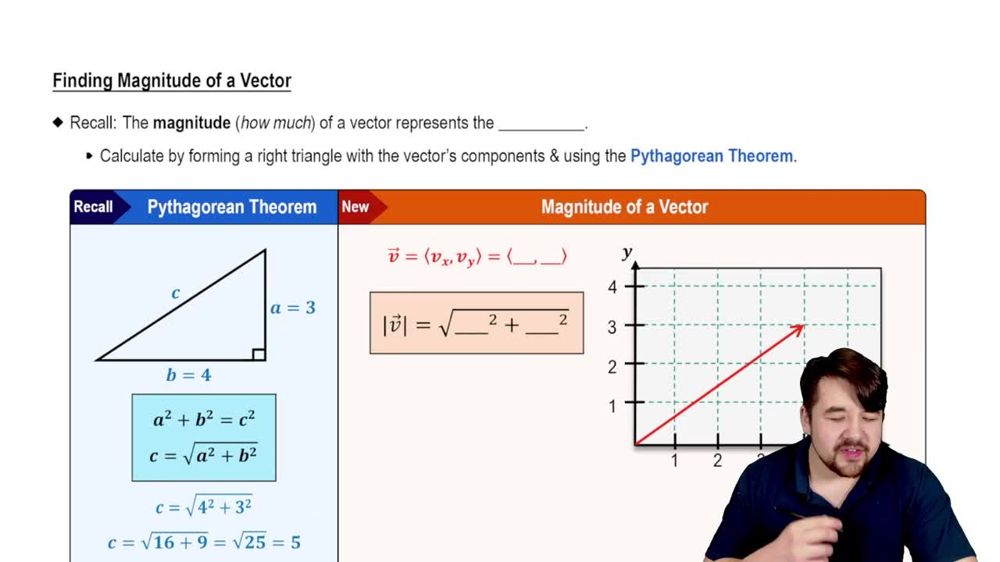
 04:44
04:44