Given u = 〈-2, 5〉 and v = 〈4, 3〉, find each of the following. v - u
Verified step by step guidance
1
Identify the given vectors: \( \mathbf{u} = \langle -2, 5 \rangle \) and \( \mathbf{v} = \langle 4, 3 \rangle \).
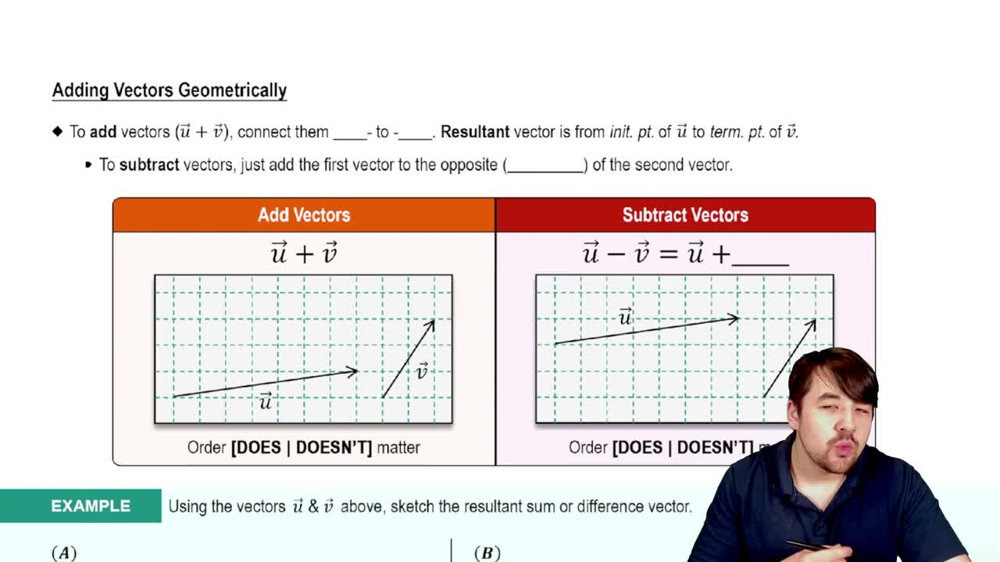
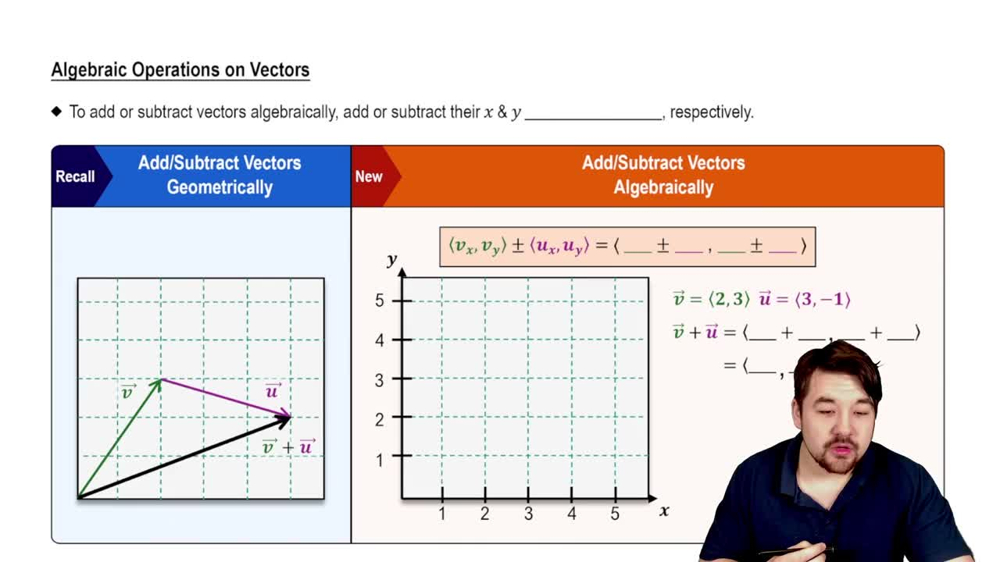
Recall that vector subtraction \( \mathbf{v} - \mathbf{u} \) is performed component-wise: subtract the corresponding components of \( \mathbf{u} \) from \( \mathbf{v} \).
Set up the subtraction for each component: \( (v_x - u_x, v_y - u_y) \), where \( v_x = 4, u_x = -2, v_y = 3, u_y = 5 \).
Calculate each component difference separately: \( 4 - (-2) \) for the x-component and \( 3 - 5 \) for the y-component.
Combine the results to write the vector \( \mathbf{v} - \mathbf{u} \) as \( \langle 4 - (-2), 3 - 5 \rangle \).
Verified video answer for a similar problem:
This video solution was recommended by our tutors as helpful for the problem above
Play a video:
0 Comments
Key Concepts
Here are the essential concepts you must grasp in order to answer the question correctly.
Vector Representation
Vectors are quantities defined by both magnitude and direction, often represented as ordered pairs or tuples in two dimensions. For example, u = 〈-2, 5〉 indicates a vector with components -2 along the x-axis and 5 along the y-axis.
Vector subtraction involves subtracting corresponding components of two vectors. For vectors v = 〈v₁, v₂〉 and u = 〈u₁, u₂〉, the difference v - u is 〈v₁ - u₁, v₂ - u₂〉, resulting in a new vector.
Operations on vectors such as addition and subtraction are performed component-wise, meaning each component is handled independently. This simplifies calculations and helps visualize vector operations geometrically.

 Verified step by step guidance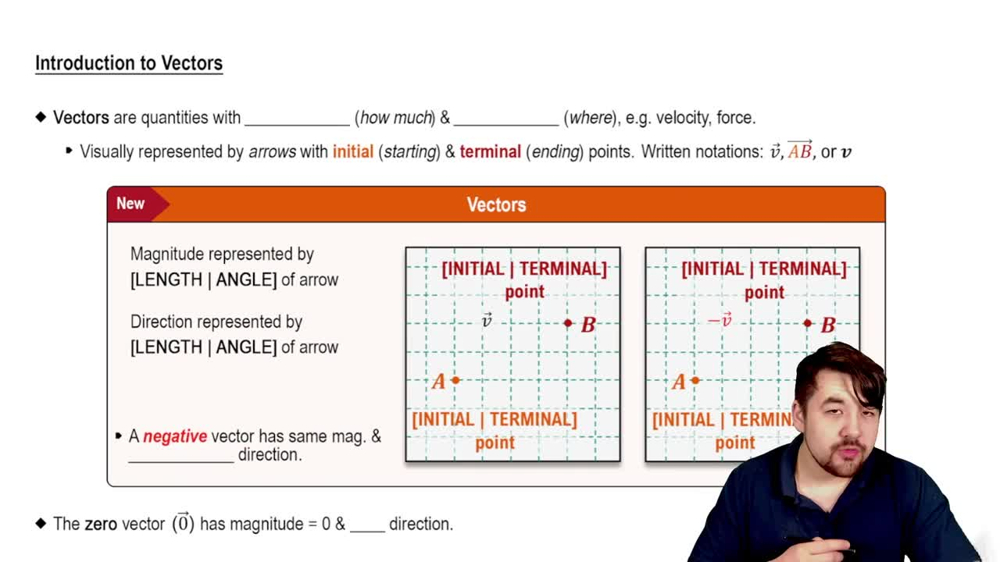
 03:48
03:48