Find the direction of the following vector: .
Table of contents
- 0. Review of College Algebra4h 45m
- 1. Measuring Angles40m
- 2. Trigonometric Functions on Right Triangles2h 5m
- 3. Unit Circle1h 19m
- 4. Graphing Trigonometric Functions1h 19m
- 5. Inverse Trigonometric Functions and Basic Trigonometric Equations1h 41m
- 6. Trigonometric Identities and More Equations2h 34m
- 7. Non-Right Triangles1h 38m
- 8. Vectors2h 25m
- 9. Polar Equations2h 5m
- 10. Parametric Equations1h 6m
- 11. Graphing Complex Numbers1h 7m
8. Vectors
Direction of a Vector
Problem 62
Textbook Question
Find the magnitude ||v||, to the nearest hundredth, and the direction angle θ, to the nearest tenth of a degree, for each given vector v.
v = 2i - 8j
Verified step by step guidance1
Identify the components of the vector \( \mathbf{v} = 2\mathbf{i} - 8\mathbf{j} \). Here, the x-component \( v_x = 2 \) and the y-component \( v_y = -8 \).
Calculate the magnitude \( ||\mathbf{v}|| \) using the formula for the length of a vector in two dimensions:
\[ ||\mathbf{v}|| = \sqrt{v_x^2 + v_y^2} \]
Substitute the values of \( v_x \) and \( v_y \) into this formula.
Find the direction angle \( \theta \) of the vector relative to the positive x-axis using the inverse tangent function:
\[ \theta = \tan^{-1} \left( \frac{v_y}{v_x} \right) \]
Substitute the values of \( v_y \) and \( v_x \) into this formula.
Since the vector has a negative y-component and a positive x-component, determine the correct quadrant for \( \theta \) and adjust the angle accordingly to get the direction angle measured counterclockwise from the positive x-axis.
Express the magnitude rounded to the nearest hundredth and the direction angle \( \theta \) rounded to the nearest tenth of a degree.
Verified video answer for a similar problem:This video solution was recommended by our tutors as helpful for the problem above
Video duration:
3mPlay a video:
0 Comments
Key Concepts
Here are the essential concepts you must grasp in order to answer the question correctly.
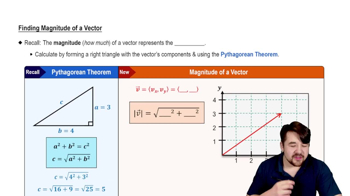
Vector Magnitude
The magnitude of a vector represents its length and is calculated using the Pythagorean theorem. For a vector v = ai + bj, the magnitude ||v|| is √(a² + b²). This gives a non-negative scalar value indicating the vector's size regardless of direction.
Recommended video:
Finding Magnitude of a Vector
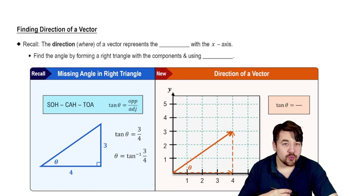
Direction Angle of a Vector
The direction angle θ of a vector in the plane is the angle it makes with the positive x-axis, measured counterclockwise. It can be found using θ = arctan(b/a), where a and b are the vector's components. Adjustments may be needed based on the quadrant.
Recommended video:
Finding Direction of a Vector
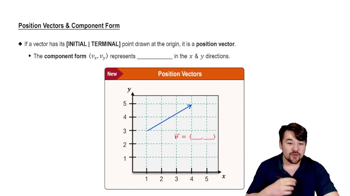
Component Form of Vectors
Vectors in two dimensions are often expressed in component form as v = ai + bj, where a and b are the horizontal and vertical components, respectively. Understanding these components is essential for calculating magnitude and direction.
Recommended video:
Position Vectors & Component Form
Related Videos
Related Practice
Multiple Choice
388
views