Which one of the following equations has solution π? a. arccos (―1) = x b. arccos 1 = x c. arcsin (―1) = x
Verified step by step guidance
1
Recall the definition of the inverse cosine function, arccos, which returns an angle \(x\) in the range \(0 \leq x \leq \pi\) such that \(\cos x\) equals the given value.
Evaluate each option by considering the cosine or sine values at \(x = \pi\):
For option (a), check if \(\arccos(-1) = \pi\) because \(\cos \pi = -1\); this suggests \(x = \pi\) is a solution for (a).
For option (b), \(\arccos(1) = 0\) since \(\cos 0 = 1\), so \(x = \pi\) is not a solution here.
For option (c), \(\arcsin(-1) = -\frac{\pi}{2}\) because \(\sin(-\frac{\pi}{2}) = -1\), so \(x = \pi\) is not a solution here.
Verified video answer for a similar problem:
This video solution was recommended by our tutors as helpful for the problem above
Play a video:
0 Comments
Key Concepts
Here are the essential concepts you must grasp in order to answer the question correctly.
Inverse Trigonometric Functions
Inverse trigonometric functions, such as arccos and arcsin, return the angle whose trigonometric value matches the given input. They are used to find angles from known sine or cosine values, with outputs restricted to specific principal value ranges.
The arccos function has a domain of [-1, 1] and a range of [0, π], meaning it outputs angles between 0 and π radians. The arcsin function also has a domain of [-1, 1] but a range of [-π/2, π/2], so it outputs angles between -π/2 and π/2 radians.
Evaluating arccos(-1) yields π because cos(π) = -1, arccos(1) yields 0 since cos(0) = 1, and arcsin(-1) yields -π/2 because sin(-π/2) = -1. Understanding these specific values helps identify which equation has π as a solution.

 Verified step by step guidance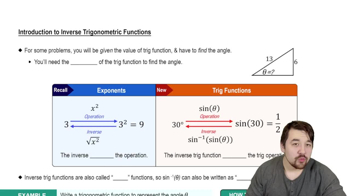
 4:28
4:28