Concept Check Match each equation in Column I with its graph in Column II. I II 47. A. 48. B. 49. (x + 3)² + (y - 2)² = 25 C. 50. D.
Table of contents
- 0. Review of College Algebra4h 45m
- 1. Measuring Angles40m
- 2. Trigonometric Functions on Right Triangles2h 5m
- 3. Unit Circle1h 19m
- 4. Graphing Trigonometric Functions1h 19m
- 5. Inverse Trigonometric Functions and Basic Trigonometric Equations1h 41m
- 6. Trigonometric Identities and More Equations2h 34m
- 7. Non-Right Triangles1h 38m
- 8. Vectors2h 25m
- 9. Polar Equations2h 5m
- 10. Parametric Equations1h 6m
- 11. Graphing Complex Numbers1h 7m
0. Review of College Algebra
Basics of Graphing
Problem 55
Textbook Question
In the following exercises, (a) find the center-radius form of the equation of each circle described, and (b) graph it. See Examples 5 and 6.
center (0, 4), radius 4
Verified step by step guidance1
Identify the general form of the equation of a circle with center \((h, k)\) and radius \(r\), which is given by:
\[ (x - h)^2 + (y - k)^2 = r^2 \]
Substitute the given center coordinates \((0, 4)\) into the formula, so \(h = 0\) and \(k = 4\). This gives:
\[ (x - 0)^2 + (y - 4)^2 = r^2 \]
Substitute the given radius \(r = 4\) into the equation, so the radius squared is \(4^2 = 16\). The equation becomes:
\[ x^2 + (y - 4)^2 = 16 \]
This is the center-radius form of the circle's equation. For graphing, plot the center at \((0, 4)\) on the coordinate plane.
From the center, use the radius length of 4 units to mark points up, down, left, and right (and optionally other directions) to sketch the circle accurately.
Verified video answer for a similar problem:This video solution was recommended by our tutors as helpful for the problem above
Play a video:
0 Comments
Key Concepts
Here are the essential concepts you must grasp in order to answer the question correctly.
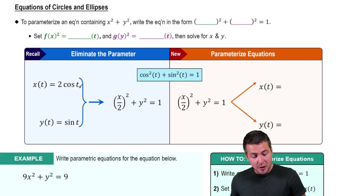
Equation of a Circle in Center-Radius Form
The center-radius form of a circle's equation is (x - h)² + (y - k)² = r², where (h, k) is the center and r is the radius. This form directly relates the geometric properties of the circle to its algebraic representation, making it easier to identify and graph.
Recommended video:
Equations of Circles & Ellipses
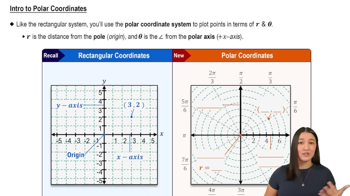
Understanding Coordinates of the Center
The center of the circle is given as a point (h, k) in the coordinate plane. Knowing the center allows you to position the circle correctly when graphing and to substitute these values into the equation to define the circle precisely.
Recommended video:
Intro to Polar Coordinates
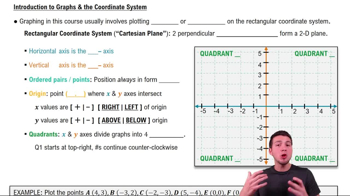
Graphing Circles on the Coordinate Plane
Graphing a circle involves plotting its center and using the radius to mark points at equal distances in all directions. This visual representation helps in understanding the circle's size and location relative to the axes.
Recommended video:
Introduction to Graphs & the Coordinate System
Related Videos
Related Practice
Textbook Question
493
views