In the following exercises, (a) find the center-radius form of the equation of each circle described, and (b) graph it. See Examples 5 and 6. center (√2, √2), radius √2
Verified step by step guidance
1
Identify the center and radius of the circle. Here, the center is given as \(\left(\sqrt{2}, \sqrt{2}\right)\) and the radius is \(\sqrt{2}\).
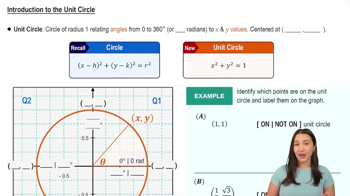
Recall the center-radius form of a circle's equation: \(\left(x - h\right)^2 + \left(y - k\right)^2 = r^2\), where \((h, k)\) is the center and \(r\) is the radius.
Substitute the given center coordinates and radius into the formula: \(\left(x - \sqrt{2}\right)^2 + \left(y - \sqrt{2}\right)^2 = \left(\sqrt{2}\right)^2\).
Simplify the right side of the equation by squaring the radius: \(\left(\sqrt{2}\right)^2 = 2\), so the equation becomes \(\left(x - \sqrt{2}\right)^2 + \left(y - \sqrt{2}\right)^2 = 2\).
For graphing, plot the center at \(\left(\sqrt{2}, \sqrt{2}\right)\) on the coordinate plane, then draw a circle with radius \(\sqrt{2}\) units around this point.
0 Comments
Key Concepts
Here are the essential concepts you must grasp in order to answer the question correctly.
Equation of a Circle in Center-Radius Form
The center-radius form of a circle's equation is (x - h)² + (y - k)² = r², where (h, k) is the center and r is the radius. This form directly relates the coordinates of any point on the circle to its center and radius, making it easy to write and analyze the circle's equation.
Coordinates like (√2, √2) involve square roots, which are irrational numbers. Recognizing how to handle these values in algebraic expressions and graphing is essential, as they affect the exact position of the circle's center on the Cartesian plane.
Graphing a circle requires plotting its center and using the radius to mark points at a fixed distance in all directions. Understanding how to translate the center-radius form into a visual representation helps in accurately sketching the circle.