In Exercises 35–44, test for symmetry and then graph each polar equation. r = cos θ/2
Verified step by step guidance
1
Identify the given polar equation: \(r = \cos \frac{\theta}{2}\).
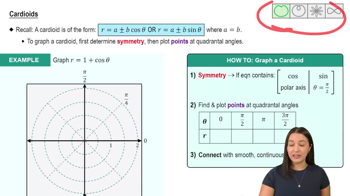
Test for symmetry about the polar axis (the horizontal axis): Replace \(\theta\) with \(-\theta\) and check if the equation remains unchanged. That is, check if \(r(\theta) = r(-\theta)\).
Test for symmetry about the line \(\theta = \frac{\pi}{2}\) (the vertical axis): Replace \(\theta\) with \(\pi - \theta\) and check if the equation remains unchanged. That is, check if \(r(\theta) = r(\pi - \theta)\).
Test for symmetry about the pole (origin): Replace \(r\) with \(-r\) and \(\theta\) with \(\theta + \pi\) and check if the equation remains unchanged. That is, check if \(r(\theta) = -r(\theta + \pi)\).
Use the results of the symmetry tests to determine which symmetries the graph has, then plot points for various values of \(\theta\) to sketch the graph of \(r = \cos \frac{\theta}{2}\).
Verified video answer for a similar problem:
This video solution was recommended by our tutors as helpful for the problem above
Video duration:
6m
Play a video:
0 Comments
Key Concepts
Here are the essential concepts you must grasp in order to answer the question correctly.
Polar Coordinates and Polar Equations
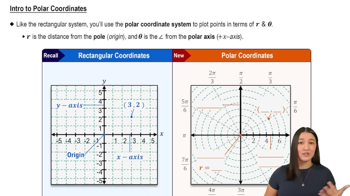
Polar coordinates represent points using a radius r and an angle θ from the positive x-axis. Polar equations express r as a function of θ, describing curves in the plane. Understanding how to interpret and plot these equations is essential for graphing.
Symmetry in polar graphs can be tested about the polar axis, the line θ = π/2, and the pole (origin). These tests involve substituting -θ, π - θ, or -r into the equation to check if the equation remains unchanged, helping to simplify graphing.
The equation r = cos(θ/2) involves a half-angle, which affects the periodicity and shape of the graph. Recognizing how the cosine function behaves with θ/2 helps predict the number of petals or loops and their orientation in the polar plot.

 6:02 minutes
 Verified step by step guidance
 05:32
05:32