In Exercises 27–32, select the representations that do not change the location of the given point. (2, − 3π/4) (2, − 7π/4)
Table of contents
- 0. Review of College Algebra4h 45m
- 1. Measuring Angles40m
- 2. Trigonometric Functions on Right Triangles2h 5m
- 3. Unit Circle1h 19m
- 4. Graphing Trigonometric Functions1h 19m
- 5. Inverse Trigonometric Functions and Basic Trigonometric Equations1h 41m
- 6. Trigonometric Identities and More Equations2h 34m
- 7. Non-Right Triangles1h 38m
- 8. Vectors2h 25m
- 9. Polar Equations2h 5m
- 10. Parametric Equations1h 6m
- 11. Graphing Complex Numbers1h 7m
9. Polar Equations
Polar Coordinate System
Problem 32
Textbook Question
In Exercises 27–32, select the representations that do not change the location of the given point. (−6, 3π) (6, −π)
Verified step by step guidance1
Understand that the problem involves identifying which representations of points in polar coordinates correspond to the same location. Polar coordinates are given as \((r, \theta)\), where \(r\) is the radius (distance from the origin) and \(\theta\) is the angle measured from the positive x-axis.
Recall that a point in polar coordinates can have multiple representations that correspond to the same location. For example, adding or subtracting \(2\pi\) to the angle \(\theta\) does not change the point's location because angles differing by full rotations point in the same direction.
Also remember that changing the sign of \(r\) and adding \(\pi\) to the angle \(\theta\) gives an equivalent point: \((r, \theta) = (-r, \theta + \pi)\). This means that \((r, \theta)\) and \((-r, \theta + \pi)\) represent the same point.
For the point \((-6, 3\pi)\), consider converting it using the rule above: change \(r\) to positive \$6$ and add \(\pi\) to the angle \(3\pi\). This will give an equivalent representation with positive radius.
For the point \((6, -\pi)\), consider adding \(2\pi\) to the angle \(-\pi\) to get an equivalent angle in the standard range \([0, 2\pi)\). This will help identify if the location remains the same.
Verified video answer for a similar problem:This video solution was recommended by our tutors as helpful for the problem above
Video duration:
5mPlay a video:
0 Comments
Key Concepts
Here are the essential concepts you must grasp in order to answer the question correctly.
Polar Coordinates and Their Representation
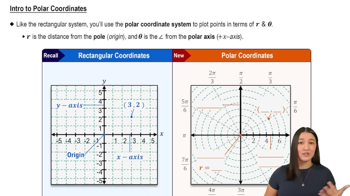
Polar coordinates represent points in the plane using a radius and an angle, written as (r, θ). The radius r indicates the distance from the origin, and θ is the angle measured from the positive x-axis. Understanding how points are plotted in polar form is essential to analyze transformations that affect their location.
Recommended video:
Intro to Polar Coordinates
Equivalent Polar Coordinates
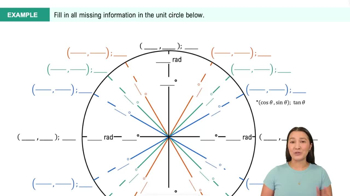
A single point in polar coordinates can have multiple representations due to periodicity of angles and sign changes in radius. For example, (r, θ) is equivalent to (r, θ + 2πk) for any integer k, and also to (−r, θ + π + 2πk). Recognizing these equivalences helps identify which transformations preserve the point's location.
Recommended video:
Intro to Polar Coordinates
Effect of Changing Sign of Radius and Angle
Changing the sign of the radius or adding/subtracting multiples of π or 2π to the angle can produce different coordinate pairs representing the same point. For instance, (−r, θ) corresponds to (r, θ + π), so understanding these relationships is key to determining which representations do not change the point's position.
Recommended video:
Example 2
Related Videos
Related Practice
Textbook Question
600
views