Determine whether each relation defines y as a function of x. Give the domain and range. See Example 5. y = √(4x + 1)
Verified step by step guidance
1
Step 1: Understand the given relation. The equation is \(y = \sqrt{4x + 1}\). This means \(y\) is defined as the square root of the expression \$4x + 1$.
Step 2: Determine if \(y\) is a function of \(x\). For each value of \(x\), check if there is exactly one corresponding value of \(y\). Since the square root function outputs only the non-negative root, for each \(x\) that makes \$4x + 1\( non-negative, there is exactly one \)y\(. Therefore, \)y\( is a function of \)x$.
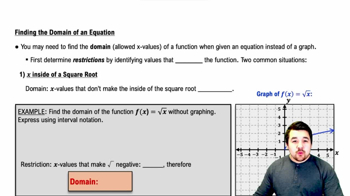
Step 3: Find the domain of the function. The expression inside the square root, \$4x + 1\(, must be greater than or equal to zero to keep \)y$ real. Set up the inequality: \(4x + 1 \geq 0\).
Step 4: Solve the inequality for \(x\). Subtract 1 from both sides: \(4x \geq -1\), then divide both sides by 4: \(x \geq -\frac{1}{4}\). So, the domain is all real numbers \(x\) such that \(x \geq -\frac{1}{4}\).
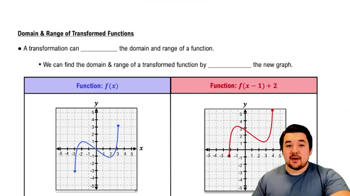
Step 5: Determine the range of the function. Since \(y = \sqrt{4x + 1}\) and the square root function outputs values greater than or equal to zero, the smallest value of \(y\) is 0 (when \(x = -\frac{1}{4}\)). As \(x\) increases, \(y\) increases without bound. Therefore, the range is \(y \geq 0\).
Verified video answer for a similar problem:
This video solution was recommended by our tutors as helpful for the problem above
Video duration:
5m
Play a video:
0 Comments
Key Concepts
Here are the essential concepts you must grasp in order to answer the question correctly.
Definition of a Function
A function is a relation where each input x corresponds to exactly one output y. To determine if y is a function of x, check if for every x-value there is only one y-value. If multiple y-values exist for a single x, the relation is not a function.
The domain is the set of all possible input values (x-values) for which the function is defined. For expressions involving square roots, the radicand must be non-negative to keep the output real, so the domain is restricted accordingly.
The range is the set of all possible output values (y-values) the function can take. For a square root function, the output is always non-negative since the square root of a non-negative number is non-negative, which helps determine the range.

 5:18 minutes
 Verified step by step guidance
 5:57
5:57