In Exercises 37–44, find the product of the complex numbers. Leave answers in polar form. z₁ = 6(cos 20° + i sin 20°) z₂ = 5(cos 50° + i sin 50°)
Table of contents
- 0. Review of College Algebra4h 45m
- 1. Measuring Angles40m
- 2. Trigonometric Functions on Right Triangles2h 5m
- 3. Unit Circle1h 19m
- 4. Graphing Trigonometric Functions1h 19m
- 5. Inverse Trigonometric Functions and Basic Trigonometric Equations1h 41m
- 6. Trigonometric Identities and More Equations2h 34m
- 7. Non-Right Triangles1h 38m
- 8. Vectors2h 25m
- 9. Polar Equations2h 5m
- 10. Parametric Equations1h 6m
- 11. Graphing Complex Numbers1h 7m
11. Graphing Complex Numbers
Products and Quotients of Complex Numbers
Problem 23
Textbook Question
In Exercises 22–24, find the quotient z₁/z₂ of the complex numbers. Leave answers in polar form.
z₁ = 5 (cos 4π/3 + i sin 4π/3)
z₂ = 10 (cos π/3 + i sin π/3)
Verified step by step guidance1
Recall that when dividing two complex numbers in polar form, \( z_1 = r_1 (\cos \theta_1 + i \sin \theta_1) \) and \( z_2 = r_2 (\cos \theta_2 + i \sin \theta_2) \), the quotient \( \frac{z_1}{z_2} \) is given by \( \frac{r_1}{r_2} \left( \cos(\theta_1 - \theta_2) + i \sin(\theta_1 - \theta_2) \right) \).
Identify the magnitudes and angles from the given complex numbers: \( r_1 = 5 \), \( \theta_1 = \frac{4\pi}{3} \), \( r_2 = 10 \), and \( \theta_2 = \frac{\pi}{3} \).
Calculate the quotient of the magnitudes: \( \frac{r_1}{r_2} = \frac{5}{10} \).
Find the difference of the angles: \( \theta_1 - \theta_2 = \frac{4\pi}{3} - \frac{\pi}{3} \).
Write the quotient \( \frac{z_1}{z_2} \) in polar form using the results from steps 3 and 4: \( \frac{5}{10} \left( \cos \left( \frac{4\pi}{3} - \frac{\pi}{3} \right) + i \sin \left( \frac{4\pi}{3} - \frac{\pi}{3} \right) \right) \).
Verified video answer for a similar problem:This video solution was recommended by our tutors as helpful for the problem above
Video duration:
3mPlay a video:
0 Comments
Key Concepts
Here are the essential concepts you must grasp in order to answer the question correctly.
Polar Form of Complex Numbers
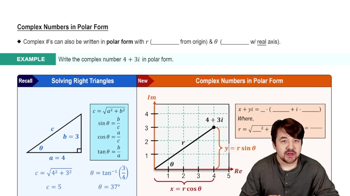
A complex number can be expressed in polar form as r(cos θ + i sin θ), where r is the magnitude and θ is the argument (angle). This form is useful for multiplication and division because it separates the magnitude and angle components.
Recommended video:
Complex Numbers In Polar Form
Division of Complex Numbers in Polar Form
To divide two complex numbers in polar form, divide their magnitudes and subtract the angles: (r₁/r₂) [cos(θ₁ - θ₂) + i sin(θ₁ - θ₂)]. This simplifies the operation compared to Cartesian form.
Recommended video:
Complex Numbers In Polar Form
Trigonometric Identities for Cosine and Sine
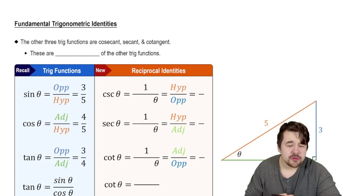
Understanding the values of cosine and sine at standard angles (like π/3 and 4π/3) helps in simplifying the final expression. These identities allow you to interpret or convert the polar form results accurately.
Recommended video:
Fundamental Trigonometric Identities
Related Videos
Related Practice
Textbook Question
485
views