In Exercises 37–52, perform the indicated operations and write the result in standard form. (3√(−5) )( −4√(−12) )
Verified step by step guidance
1
Recognize that the expression involves multiplying two complex numbers in the form of \( a\sqrt{-1} \), which can be rewritten using the imaginary unit \( i = \sqrt{-1} \). So, rewrite \( \sqrt{-5} \) as \( \sqrt{5}i \) and \( \sqrt{-12} \) as \( \sqrt{12}i \).
Rewrite the original expression \( (3\sqrt{-5})(-4\sqrt{-12}) \) as \( (3\sqrt{5}i)(-4\sqrt{12}i) \).
Multiply the coefficients and the square root parts separately: multiply \( 3 \times -4 \) and \( \sqrt{5} \times \sqrt{12} \), and multiply the imaginary units \( i \times i \).
Recall that \( i \times i = i^2 = -1 \), so replace \( i^2 \) with \( -1 \) in your expression.
Simplify the expression by multiplying all numerical parts and applying the \( -1 \) from \( i^2 \), then write the final result in the form \( a + bi \), which is the standard form for complex numbers.
Verified video answer for a similar problem:
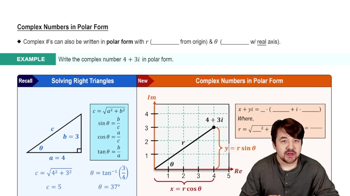
This video solution was recommended by our tutors as helpful for the problem above
Video duration:
3m
Play a video:
0 Comments
Key Concepts
Here are the essential concepts you must grasp in order to answer the question correctly.
Complex Numbers and Standard Form
Complex numbers are expressed in the form a + bi, where a is the real part and b is the imaginary part. The standard form requires separating and simplifying these parts after performing operations like multiplication.
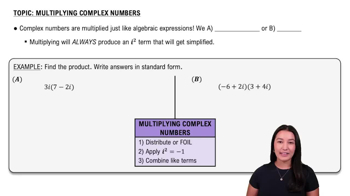
Multiplying complex numbers involves using the distributive property (FOIL) and applying i² = -1 to simplify terms. This process combines real and imaginary parts to form a new complex number.
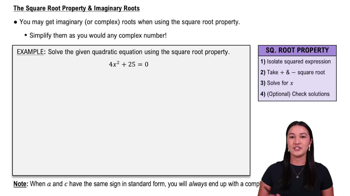
Square roots of negative numbers are expressed using imaginary unit i, where √(-n) = i√n. Simplifying these roots is essential before performing multiplication to correctly handle the imaginary components.