Concept Check Let A = {1, 2, 3, 4, 5, 6}, B = {1, 3, 5,}, C = {1, 6}, and D = {4}. Find each set. a. A ∩ D b. B ∩ C c. B ∩ A d. C ∩ A
Table of contents
- 0. Review of College Algebra4h 45m
- 1. Measuring Angles40m
- 2. Trigonometric Functions on Right Triangles2h 5m
- 3. Unit Circle1h 19m
- 4. Graphing Trigonometric Functions1h 19m
- 5. Inverse Trigonometric Functions and Basic Trigonometric Equations1h 41m
- 6. Trigonometric Identities and More Equations2h 34m
- 7. Non-Right Triangles1h 38m
- 8. Vectors2h 25m
- 9. Polar Equations2h 5m
- 10. Parametric Equations1h 6m
- 11. Graphing Complex Numbers1h 7m
0. Review of College Algebra
Functions
Problem 32
Textbook Question
Let A = {-6, -12⁄4, -5⁄8, -√3, 0, ¼, 1, 2π, 3, √12}. List all the elements of A that belong to each set. Rational numbers
Verified step by step guidance1
Recall that rational numbers are numbers that can be expressed as a fraction \( \frac{p}{q} \) where \( p \) and \( q \) are integers and \( q \neq 0 \). This includes integers, fractions, and terminating or repeating decimals.
Examine each element of the set \( A = \{-6, -\frac{12}{4}, -\frac{5}{8}, -\sqrt{3}, 0, \frac{1}{4}, 1, 2\pi, 3, \sqrt{12} \} \) to determine if it can be written as a fraction of integers.
Identify \( -6 \) as rational because it is an integer, which can be written as \( \frac{-6}{1} \).
Simplify \( -\frac{12}{4} \) to \( -3 \), which is also an integer and therefore rational.
Recognize \( -\frac{5}{8} \), \( 0 \), \( \frac{1}{4} \), \( 1 \), and \( 3 \) as rational numbers since they are either fractions or integers.
Verified video answer for a similar problem:This video solution was recommended by our tutors as helpful for the problem above
Video duration:
3mPlay a video:
0 Comments
Key Concepts
Here are the essential concepts you must grasp in order to answer the question correctly.
Rational Numbers
Rational numbers are numbers that can be expressed as the quotient of two integers, where the denominator is not zero. This includes integers, fractions, and finite or repeating decimals. For example, 1/2, -3, and 0.75 are rational, while numbers like √3 or π are not.
Recommended video:
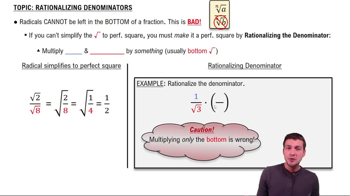
Rationalizing Denominators
Set Membership and Classification
Understanding set membership involves determining whether an element belongs to a particular set based on its properties. Classifying numbers into sets like rational or irrational requires analyzing their form and characteristics, such as whether they can be expressed as a fraction or not.
Recommended video:
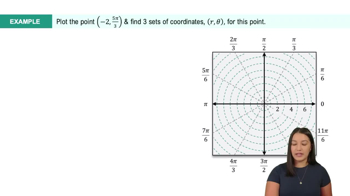
Determining Different Coordinates for the Same Point Example 2
Simplification of Expressions
Simplifying expressions, such as fractions or radicals, helps identify the nature of numbers. For example, simplifying -12/4 to -3 or √12 to 2√3 clarifies whether the number is rational or irrational, aiding in accurate classification within sets.
Recommended video:
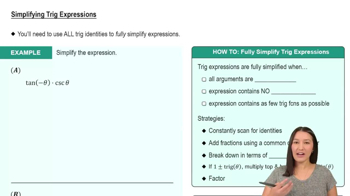
Simplifying Trig Expressions
Related Videos
Related Practice
Textbook Question
7
views