Let A = {-6, -12⁄4, -5⁄8, -√3, 0, ¼, 1, 2π, 3, √12}. List all the elements of A that belong to each set. Whole numbers
Table of contents
- 0. Review of College Algebra4h 45m
- 1. Measuring Angles40m
- 2. Trigonometric Functions on Right Triangles2h 5m
- 3. Unit Circle1h 19m
- 4. Graphing Trigonometric Functions1h 19m
- 5. Inverse Trigonometric Functions and Basic Trigonometric Equations1h 41m
- 6. Trigonometric Identities and More Equations2h 34m
- 7. Non-Right Triangles1h 38m
- 8. Vectors2h 25m
- 9. Polar Equations2h 5m
- 10. Parametric Equations1h 6m
- 11. Graphing Complex Numbers1h 7m
0. Review of College Algebra
Functions
Problem 34
Textbook Question
Let A = {-6, -12⁄4, -5⁄8, -√3, 0, ¼, 1, 2π, 3, √12}. List all the elements of A that belong to each set. Real numbers
Verified step by step guidance1
Recall that the set of real numbers includes all rational and irrational numbers, including integers, fractions, and irrational roots, but excludes complex numbers with imaginary parts.
Examine each element of the set \(A = \{-6, -\frac{12}{4}, -\frac{5}{8}, -\sqrt{3}, 0, \frac{1}{4}, 1, 2\pi, 3, \sqrt{12}\}\) to determine if it is a real number.
Note that \(-6\) is an integer, so it is a real number.
Simplify \(-\frac{12}{4}\) to \(-3\), which is an integer and thus a real number.
Recognize that \(-\frac{5}{8}\) is a rational number (a fraction), so it is real.
Understand that \(-\sqrt{3}\) is an irrational number (since \(\sqrt{3}\) is irrational), but still a real number.
Note that \$0$ is a real number.
Recognize that \(\frac{1}{4}\) is a rational number, so it is real.
Note that \$1$ is an integer and thus real.
Understand that \(2\pi\) is a real number because \(\pi\) is irrational but real, and multiplying by 2 keeps it real.
Note that \$3$ is an integer and real.
Simplify \(\sqrt{12}\) to \(2\sqrt{3}\), which is irrational but real.
Conclude that all elements in set \(A\) are real numbers.
Verified video answer for a similar problem:This video solution was recommended by our tutors as helpful for the problem above
Video duration:
2mPlay a video:
0 Comments
Key Concepts
Here are the essential concepts you must grasp in order to answer the question correctly.
Real Numbers
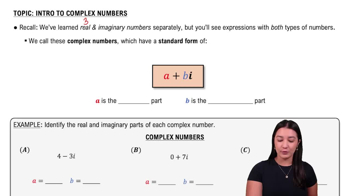
Real numbers include all rational and irrational numbers, encompassing integers, fractions, decimals, and roots. They can be represented on the number line and do not include imaginary or complex numbers. Understanding this set helps identify which elements from a given list are real.
Recommended video:
Introduction to Complex Numbers
Rational and Irrational Numbers
Rational numbers can be expressed as a fraction of two integers, while irrational numbers cannot be written as simple fractions and have non-repeating, non-terminating decimals. Recognizing these helps classify elements like -5/8 (rational) and -√3 (irrational) within the real numbers.
Recommended video:
Rationalizing Denominators
Simplification of Expressions
Simplifying expressions such as fractions and roots is essential to accurately identify and compare numbers. For example, -12/4 simplifies to -3, and √12 simplifies to 2√3, aiding in clearer classification within sets like real numbers.
Recommended video:
Simplifying Trig Expressions
Related Videos
Related Practice
Textbook Question
11
views