In Exercises 1–8, a point on the terminal side of angle θ is given. Find the exact value of each of the six trigonometric functions of θ. (3, 7)
Verified step by step guidance
1
Identify the coordinates of the point on the terminal side of angle \( \theta \). Here, the point is \( (3, 7) \), so \( x = 3 \) and \( y = 7 \).
Calculate the radius \( r \), which is the distance from the origin to the point, using the formula \( r = \sqrt{x^2 + y^2} \). Substitute the values to get \( r = \sqrt{3^2 + 7^2} \).
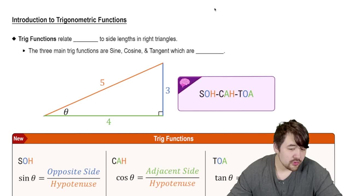
Recall the definitions of the six trigonometric functions in terms of \( x \), \( y \), and \( r \):
\[ \sin \theta = \frac{y}{r}, \quad \cos \theta = \frac{x}{r}, \quad \tan \theta = \frac{y}{x}, \quad \csc \theta = \frac{r}{y}, \quad \sec \theta = \frac{r}{x}, \quad \cot \theta = \frac{x}{y} \]
Substitute the values of \( x \), \( y \), and \( r \) into each of the six functions to express them exactly in terms of radicals and integers.
Simplify each expression if possible, but do not approximate the values numerically to maintain exactness.
Verified video answer for a similar problem:
This video solution was recommended by our tutors as helpful for the problem above
Video duration:
6m
Play a video:
0 Comments
Key Concepts
Here are the essential concepts you must grasp in order to answer the question correctly.
Coordinates and the Terminal Side of an Angle
The terminal side of an angle θ in standard position passes through a point (x, y). These coordinates represent the position on the Cartesian plane, which helps determine the values of trigonometric functions based on the angle's location.
The six trigonometric functions—sine, cosine, tangent, cosecant, secant, and cotangent—are ratios involving the coordinates (x, y) and the radius r = √(x² + y²). For example, sin(θ) = y/r and cos(θ) = x/r, linking geometry to trigonometry.
The radius r is the distance from the origin to the point (x, y), calculated using the Pythagorean theorem: r = √(x² + y²). This value is essential for finding the exact values of trigonometric functions since it normalizes the coordinates.

 6:28 minutes
 Verified step by step guidance
 05:32
05:32