Table of contents
- 0. Review of College Algebra4h 45m
- 1. Measuring Angles40m
- 2. Trigonometric Functions on Right Triangles2h 5m
- 3. Unit Circle1h 19m
- 4. Graphing Trigonometric Functions1h 19m
- 5. Inverse Trigonometric Functions and Basic Trigonometric Equations1h 41m
- 6. Trigonometric Identities and More Equations2h 34m
- 7. Non-Right Triangles1h 38m
- 8. Vectors2h 25m
- 9. Polar Equations2h 5m
- 10. Parametric Equations1h 6m
- 11. Graphing Complex Numbers1h 7m
2. Trigonometric Functions on Right Triangles
Trigonometric Functions on Right Triangles
Problem 1.2.65
Textbook Question
In Exercises 63–68, find the exact value of each expression. Do not use a calculator. 1 + sin² 40° + sin² 50°
Verified step by step guidance1
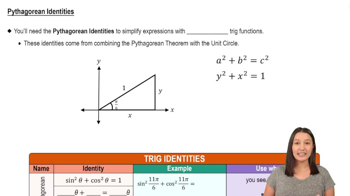
Recall the Pythagorean identity: \(\sin^2 \theta + \cos^2 \theta = 1\). This identity will help us relate sine and cosine values.
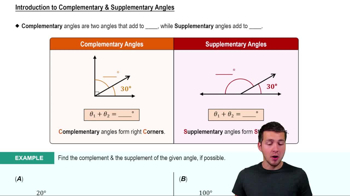
Notice that \(\sin^2 40^\circ\) and \(\sin^2 50^\circ\) are involved. Since \(40^\circ\) and \(50^\circ\) are complementary angles (they add up to \(90^\circ\)), use the complementary angle identity: \(\sin 50^\circ = \cos 40^\circ\).
Rewrite \(\sin^2 50^\circ\) as \(\cos^2 40^\circ\) using the complementary angle identity.
Substitute \(\sin^2 50^\circ\) with \(\cos^2 40^\circ\) in the expression: \(1 + \sin^2 40^\circ + \cos^2 40^\circ\).
Apply the Pythagorean identity to \(\sin^2 40^\circ + \cos^2 40^\circ\), which equals 1, so the entire expression simplifies to \$1 + 1 = 2$.
Verified video answer for a similar problem:This video solution was recommended by our tutors as helpful for the problem above
Video duration:
2mPlay a video:
0 Comments
Key Concepts
Here are the essential concepts you must grasp in order to answer the question correctly.
Pythagorean Identity
The Pythagorean identity states that for any angle θ, sin²θ + cos²θ = 1. This fundamental relationship helps simplify expressions involving squares of sine and cosine functions by converting one into the other.
Recommended video:
Pythagorean Identities
Complementary Angles in Trigonometry
Complementary angles add up to 90°. The sine of an angle equals the cosine of its complement, i.e., sin(θ) = cos(90° - θ). This property allows rewriting sin² 50° as cos² 40°, facilitating simplification.
Recommended video:
Intro to Complementary & Supplementary Angles
Exact Values and Simplification without Calculator
Finding exact values involves using known identities and angle relationships rather than decimal approximations. By applying identities and angle properties, expressions can be simplified to exact numerical values or simple constants.
Recommended video:
Sine, Cosine, & Tangent of 30°, 45°, & 60°
Related Videos
Related Practice
Textbook Question
In Exercises 9–16, use the given triangles to evaluate each expression. If necessary, express the value without a square root in the denominator by rationalizing the denominator.cot 𝜋/3
554
views