Add or subtract, as indicated. See Example 4. ((17y + 3)/(9y + 7)) - ((-10y - 18)/(9y + 7 ))
Verified step by step guidance
1
Identify the expression as a subtraction of two fractions: \(\frac{17y + 3}{9y + 7} - \frac{10y + 18}{9y + 7}\).
Since both fractions have the same denominator \$9y + 7$, you can combine the numerators directly over the common denominator: \(\frac{(17y + 3) - (10y + 18)}{9y + 7}\).
Distribute the subtraction sign across the second numerator: \(\frac{17y + 3 - 10y - 18}{9y + 7}\).
Combine like terms in the numerator: combine \$17y\( and \)-10y\(, and combine \)3\( and \)-18$.
Write the simplified numerator over the denominator \$9y + 7$ to express the final simplified fraction.
Verified video answer for a similar problem:
This video solution was recommended by our tutors as helpful for the problem above
Video duration:
3m
Play a video:
0 Comments
Key Concepts
Here are the essential concepts you must grasp in order to answer the question correctly.
Combining Like Terms
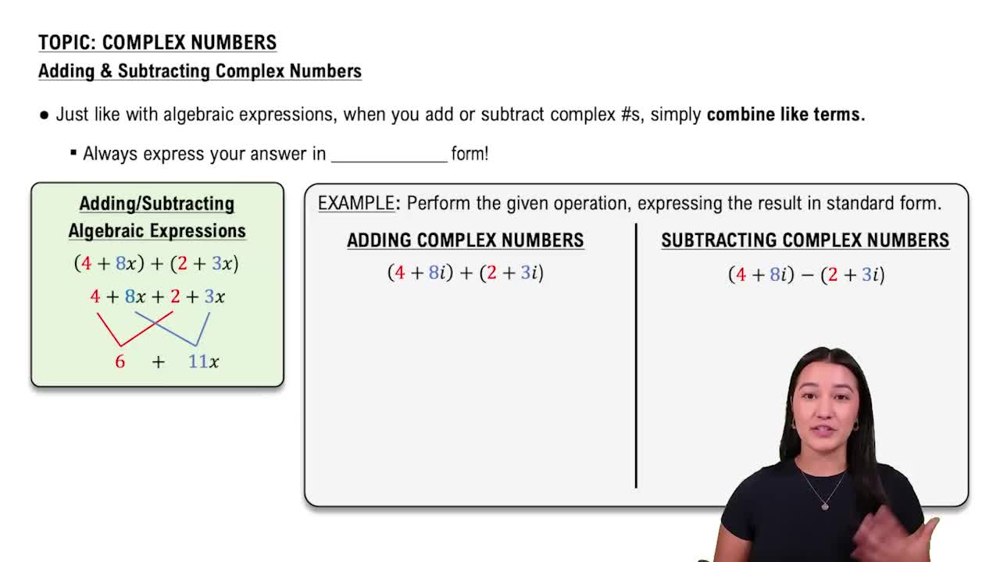
Combining like terms involves adding or subtracting terms that have the same variable raised to the same power. This simplifies expressions by reducing the number of terms, making it easier to perform further operations such as addition or subtraction of fractions.
To add or subtract rational expressions, the denominators must be the same. If they are identical, you combine the numerators directly over the common denominator. This process is similar to adding or subtracting fractions in arithmetic.
Simplifying algebraic expressions involves reducing the expression to its simplest form by performing operations like combining like terms, factoring, and canceling common factors. This helps in making the expression clearer and easier to interpret or solve.

 3:06 minutes
 Verified step by step guidance
 3:18
3:18