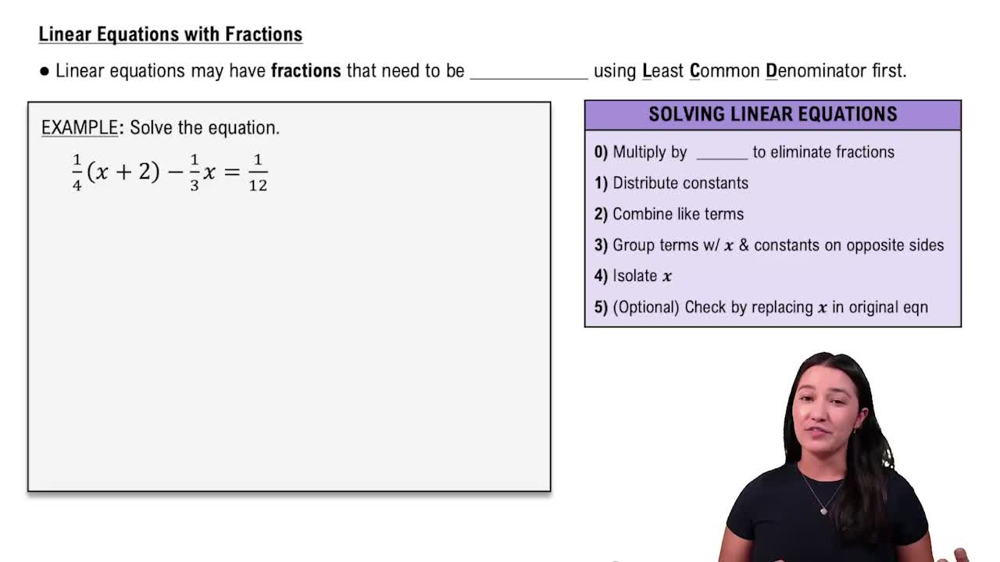
Add or subtract, as indicated. See Example 4. (5/12x²y) - (11/6xy)
Verified step by step guidance
1
Identify the two fractions to be subtracted: \(\frac{5}{12x^{2}y}\) and \(\frac{11}{6xy}\).
Find the least common denominator (LCD) of the two fractions. The denominators are \$12x^{2}y\( and \)6xy$. Determine the LCD by taking the least common multiple of the numerical coefficients and the highest powers of variables present.
Rewrite each fraction with the LCD as the new denominator by multiplying numerator and denominator appropriately to create equivalent fractions.
Subtract the numerators of the equivalent fractions while keeping the LCD as the common denominator: \(\frac{\text{new numerator 1} - \text{new numerator 2}}{\text{LCD}}\).
Simplify the resulting expression by combining like terms in the numerator and reducing the fraction if possible.
Verified video answer for a similar problem:
This video solution was recommended by our tutors as helpful for the problem above
Video duration:
2m
Play a video:
0 Comments
Key Concepts
Here are the essential concepts you must grasp in order to answer the question correctly.
Finding a Common Denominator
To add or subtract fractions, they must have the same denominator. This involves finding the least common denominator (LCD), which is the least common multiple of the denominators. For algebraic expressions, the LCD includes all variable factors with the highest powers present.
Simplifying algebraic fractions requires factoring numerators and denominators to cancel common factors. This process reduces the expression to its simplest form, making addition or subtraction easier and the final answer clearer.
Once fractions share a common denominator, add or subtract their numerators while keeping the denominator unchanged. After combining, simplify the resulting fraction if possible by factoring and reducing common terms.