Use substitution to determine whether the given x-value is a solution of the equation.
Verified step by step guidance
1
First, substitute the given value of \(x = \frac{5\pi}{12}\) into the left side of the equation \(\tan 2x\). This means calculating \(\tan\left(2 \times \frac{5\pi}{12}\right)\).
Simplify the expression inside the tangent function: \(2 \times \frac{5\pi}{12} = \frac{10\pi}{12} = \frac{5\pi}{6}\), so you need to find \(\tan\left(\frac{5\pi}{6}\right)\).
Recall or use the unit circle to find the exact value of \(\tan\left(\frac{5\pi}{6}\right)\). Remember that \(\frac{5\pi}{6}\) is in the second quadrant where tangent is negative.
Next, evaluate the right side of the equation, which is \(-\frac{\sqrt{3}}{3}\). This is a constant value you can compare with the left side.
Finally, compare the value of \(\tan\left(\frac{5\pi}{6}\right)\) with \(-\frac{\sqrt{3}}{3}\). If they are equal, then \(x = \frac{5\pi}{12}\) is a solution; if not, it is not a solution.
Verified video answer for a similar problem:
This video solution was recommended by our tutors as helpful for the problem above
Video duration:
4m
Play a video:
0 Comments
Key Concepts
Here are the essential concepts you must grasp in order to answer the question correctly.
Tangent Function and Its Properties
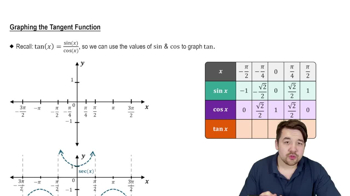
The tangent function, tan(θ), is defined as the ratio of sine to cosine (sin θ / cos θ). It is periodic with period π, meaning tan(θ + π) = tan(θ). Understanding how to evaluate tangent at specific angles, especially multiples of π, is essential for solving equations involving tan(2x).
Substitution involves replacing the variable x with a given value to verify if it satisfies the equation. Here, substituting x = 5π/12 into tan(2x) allows direct evaluation to check if it equals the given expression. This method helps confirm whether the proposed x-value is a solution.
Simplifying and Evaluating Trigonometric Expressions
Evaluating tan(2x) at x = 5π/12 requires simplifying the angle 2x = 5π/6 and then calculating tan(5π/6). Knowing exact values of tangent at standard angles and simplifying radicals like √3/3 is crucial to compare both sides of the equation accurately.