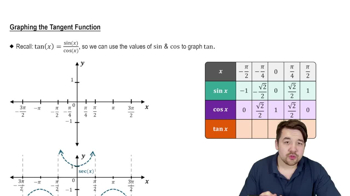
Recall that the tangent function is defined as \(\tan x = \frac{\sin x}{\cos x}\), and it equals zero when the numerator, \(\sin x\), is zero (provided \(\cos x \neq 0\)).
Set the equation \(\tan x = 0\) equivalent to \(\sin x = 0\) because \(\tan x = 0\) when \(\sin x = 0\).
Find all angles \(x\) where \(\sin x = 0\). The sine function is zero at integer multiples of \(\pi\), so \(x = n\pi\), where \(n\) is any integer.
Write the general solution as \(x = n\pi\), where \(n \in \mathbb{Z}\) (the set of all integers).
If the problem specifies a domain (such as \(0 \leq x < 2\pi\)), list all values of \(x\) within that domain by substituting integer values of \(n\) accordingly.
Verified video answer for a similar problem:
This video solution was recommended by our tutors as helpful for the problem above
Video duration:
4m
Play a video:
0 Comments
Key Concepts
Here are the essential concepts you must grasp in order to answer the question correctly.
Definition of the Tangent Function
The tangent of an angle in a right triangle is the ratio of the opposite side to the adjacent side. In the unit circle, tan x is the ratio of the y-coordinate to the x-coordinate of the point on the circle. Understanding this helps identify where tan x equals zero.
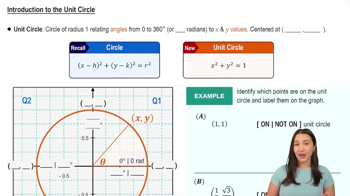
The equation tan x = 0 means the tangent value is zero, which occurs when the sine of x is zero and cosine is nonzero. On the unit circle, this happens at angles where the point lies on the x-axis, specifically at x = nπ, where n is any integer.
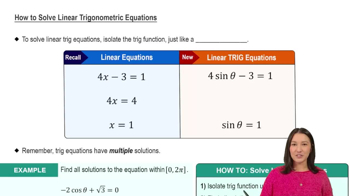
Trigonometric equations often have infinitely many solutions due to periodicity. For tan x = 0, the general solution is expressed as x = nπ, where n is any integer, capturing all angles coterminal with the principal solutions.

 4:45 minutes
 Verified step by step guidance
 5:43
5:43