Find the angle between each pair of vectors. Round to two decimal places as necessary. 〈1, 6〉, 〈-1, 7〉
Verified step by step guidance
1
Identify the two vectors given: \( \mathbf{u} = \langle 1, 6 \rangle \) and \( \mathbf{v} = \langle -1, 7 \rangle \).
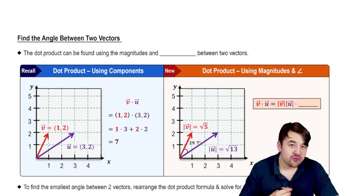
Recall the formula for the angle \( \theta \) between two vectors \( \mathbf{u} \) and \( \mathbf{v} \):
\[\cos(\theta) = \frac{\mathbf{u} \cdot \mathbf{v}}{\|\mathbf{u}\| \|\mathbf{v}\|}\]
Calculate the dot product \( \mathbf{u} \cdot \mathbf{v} \) using the formula:
\[\mathbf{u} \cdot \mathbf{v} = u_1 v_1 + u_2 v_2\]
where \( u_1, u_2 \) and \( v_1, v_2 \) are the components of \( \mathbf{u} \) and \( \mathbf{v} \) respectively.
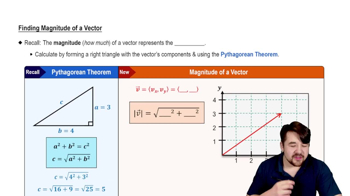
Find the magnitudes of each vector using:
\[\|\mathbf{u}\| = \sqrt{u_1^2 + u_2^2} \quad \text{and} \quad \|\mathbf{v}\| = \sqrt{v_1^2 + v_2^2}\]
Substitute the dot product and magnitudes into the cosine formula, then use the inverse cosine function to find the angle \( \theta = \cos^{-1} \left( \frac{\mathbf{u} \cdot \mathbf{v}}{\|\mathbf{u}\| \|\mathbf{v}\|} \right) \). Finally, round your answer to two decimal places.
Verified video answer for a similar problem:
This video solution was recommended by our tutors as helpful for the problem above
Play a video:
0 Comments
Key Concepts
Here are the essential concepts you must grasp in order to answer the question correctly.
Dot Product of Vectors
The dot product is a scalar value obtained by multiplying corresponding components of two vectors and summing the results. For vectors 〈x1, y1〉 and 〈x2, y2〉, it is calculated as x1*x2 + y1*y2. This product is essential for finding the angle between vectors.
The magnitude (or length) of a vector 〈x, y〉 is found using the formula √(x² + y²). It represents the distance from the origin to the point defined by the vector and is used to normalize vectors when calculating angles.
The angle θ between two vectors can be found using the formula cos(θ) = (dot product) / (product of magnitudes). By taking the inverse cosine (arccos) of this ratio, we obtain the angle in radians or degrees, which can then be rounded as required.

 Verified step by step guidance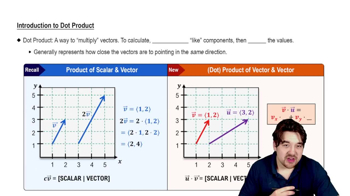
 05:40
05:40