In Exercises 1–8, use the given vectors to find v⋅w and v⋅v. v = 5i, w = j
Verified step by step guidance
1
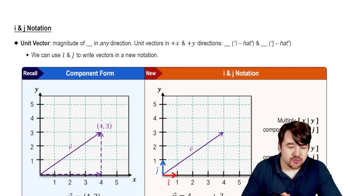
Identify the components of the vectors \( \mathbf{v} \) and \( \mathbf{w} \). Here, \( \mathbf{v} = 5\mathbf{i} = (5, 0) \) and \( \mathbf{w} = \mathbf{j} = (0, 1) \).
Recall the formula for the dot product of two vectors \( \mathbf{a} = (a_1, a_2) \) and \( \mathbf{b} = (b_1, b_2) \):
\[
\mathbf{a} \cdot \mathbf{b} = a_1 b_1 + a_2 b_2
\]
Calculate \( \mathbf{v} \cdot \mathbf{v} \) by multiplying the components of \( \mathbf{v} \) with themselves and adding:
\[
\mathbf{v} \cdot \mathbf{v} = 5 \times 5 + 0 \times 0
\]
Simplify the expressions from steps 3 and 4 to find the dot products.
Verified video answer for a similar problem:
This video solution was recommended by our tutors as helpful for the problem above
Video duration:
3m
Play a video:
0 Comments
Key Concepts
Here are the essential concepts you must grasp in order to answer the question correctly.
Dot Product of Vectors
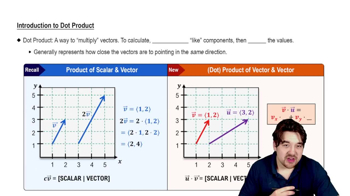
The dot product is an algebraic operation that takes two vectors and returns a scalar. It is calculated by multiplying corresponding components of the vectors and summing the results. For vectors v and w, v⋅w = v₁w₁ + v₂w₂ + ... + vₙwₙ.
In two-dimensional space, i and j are standard unit vectors along the x-axis and y-axis, respectively. Vector i = (1, 0) and vector j = (0, 1). They are orthogonal, meaning their dot product is zero.
The dot product of a vector with itself, v⋅v, equals the square of its magnitude. It is calculated by summing the squares of its components, which helps find the length or magnitude of the vector.

 3:49 minutes
 Verified step by step guidance
 05:40
05:40