In Exercises 27–38, use a calculator to find the value of each expression rounded to two decimal places. sin⁻¹ 0.3
Verified step by step guidance
1
Recognize that the expression sin⁻¹ 0.3 represents the inverse sine function, also called arcsine, which gives the angle whose sine is 0.3.
Recall that the inverse sine function is denoted as \(\sin^{-1}(x)\) or \(\arcsin(x)\), and it returns an angle in radians or degrees depending on your calculator settings.
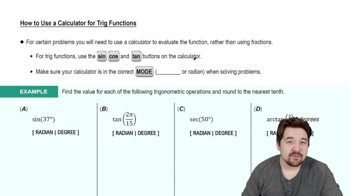
Set your calculator to the desired angle mode (degrees or radians) depending on the problem requirements. Usually, degrees are used unless otherwise specified.
Input the value 0.3 into the inverse sine function on your calculator, i.e., calculate \(\sin^{-1}(0.3)\) or \(\arcsin(0.3)\).
Read the result from the calculator and round it to two decimal places as requested.
Verified video answer for a similar problem:
This video solution was recommended by our tutors as helpful for the problem above
Video duration:
1m
Play a video:
0 Comments
Key Concepts
Here are the essential concepts you must grasp in order to answer the question correctly.
Inverse Sine Function (sin⁻¹ or arcsin)
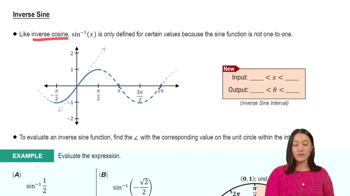
The inverse sine function, denoted as sin⁻¹ or arcsin, returns the angle whose sine value is a given number. It is used to find an angle when the sine value is known, with the output angle typically in the range of -90° to 90° (or -π/2 to π/2 radians).
Calculators can compute inverse trigonometric functions by inputting the value and selecting the appropriate function (e.g., sin⁻¹). It is important to ensure the calculator is set to the correct angle mode (degrees or radians) before calculating to get the desired unit for the answer.
Rounding involves approximating a number to a specified number of decimal places for simplicity and clarity. In this problem, the result of sin⁻¹(0.3) should be rounded to two decimal places, meaning the answer is expressed with two digits after the decimal point.

 1:35 minutes
 Verified step by step guidance
 4:03
4:03