In Exercises 27–38, use a calculator to find the value of each expression rounded to two decimal places. cos⁻¹ 3/8
Verified step by step guidance
1
Identify the expression to evaluate: \(\cos^{-1} \left( \frac{3}{8} \right)\), which means finding the angle whose cosine is \(\frac{3}{8}\).
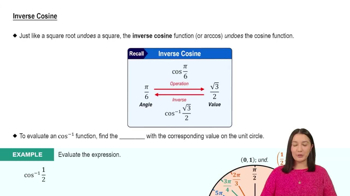
Recall that the inverse cosine function, \(\cos^{-1}(x)\), returns an angle in radians or degrees depending on the calculator mode, typically between 0 and \(\pi\) radians (or 0° and 180°).
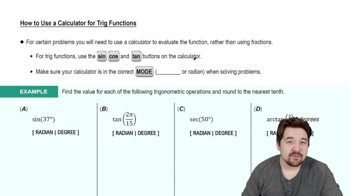
Make sure your calculator is set to the correct mode (degrees or radians) based on the problem's requirement. Since the problem does not specify, degrees is commonly used.
Use the calculator to compute \(\cos^{-1} \left( \frac{3}{8} \right)\) by entering the value \(0.375\) and then applying the inverse cosine function.
Round the resulting angle to two decimal places as requested.
Verified video answer for a similar problem:
This video solution was recommended by our tutors as helpful for the problem above
Video duration:
1m
Play a video:
0 Comments
Key Concepts
Here are the essential concepts you must grasp in order to answer the question correctly.
Inverse Cosine Function (cos⁻¹ or arccos)
The inverse cosine function returns the angle whose cosine value is a given number. It is used to find an angle when the cosine value is known, with the output typically in radians or degrees within the range 0 to π (0° to 180°).
The cosine function outputs values between -1 and 1, so its inverse function, arccos, only accepts inputs within this range. Any input outside [-1, 1] is invalid and will not produce a real angle.
Calculators can compute inverse trigonometric functions, often requiring the mode to be set to degrees or radians. For cos⁻¹(3/8), input the fraction and use the inverse cosine function to find the angle, then round the result to two decimal places.

 1:45 minutes
 Verified step by step guidance
 4:49
4:49