Solve each equation (x in radians and θ in degrees) for all exact solutions where appropriate. Round approximate answers in radians to four decimal places and approximate answers in degrees to the nearest tenth. Write answers using the least possible nonnegative angle measures. sin x (3 sin x - 1) = 1
Verified step by step guidance
1
Start by rewriting the given equation: \(\sin x (3 \sin x - 1) = 1\).
Expand the left side to get a quadratic form in terms of \(\sin x\): \(3 \sin^2 x - \sin x = 1\).
Rearrange the equation to standard quadratic form: \(3 \sin^2 x - \sin x - 1 = 0\).
Use the quadratic formula to solve for \(\sin x\), where \(a = 3\), \(b = -1\), and \(c = -1\). The formula is \(\sin x = \frac{-b \pm \sqrt{b^2 - 4ac}}{2a}\).
Find all values of \(x\) (in radians and degrees) that satisfy the solutions for \(\sin x\), considering the domain of the sine function and using the least possible nonnegative angle measures. Round approximate answers as instructed.
Verified video answer for a similar problem:
This video solution was recommended by our tutors as helpful for the problem above
Play a video:
0 Comments
Key Concepts
Here are the essential concepts you must grasp in order to answer the question correctly.
Solving Trigonometric Equations
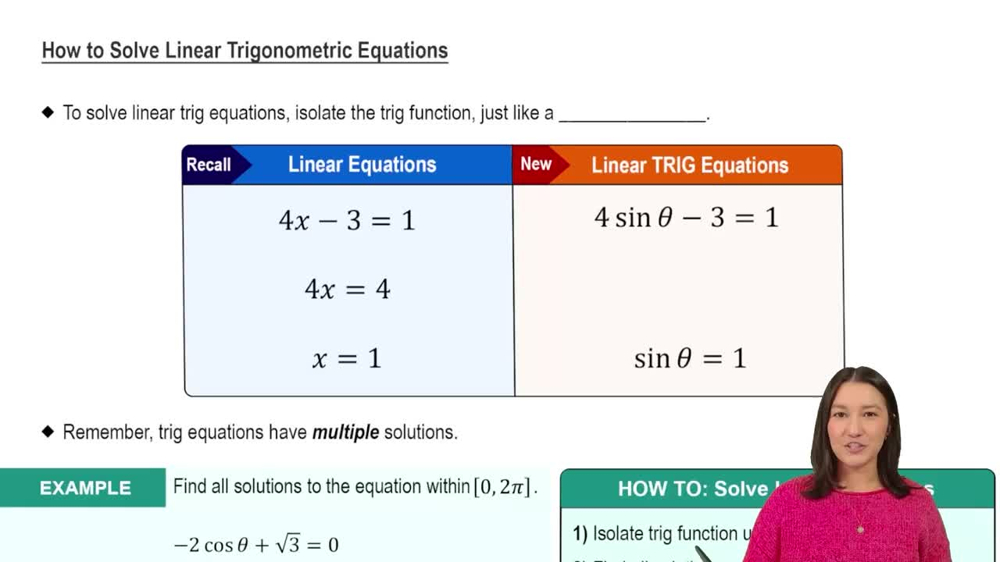
Solving trigonometric equations involves finding all angle values that satisfy the given equation. This often requires algebraic manipulation, factoring, and using inverse trigonometric functions. Solutions must consider the periodic nature of trig functions, leading to multiple valid answers within specified intervals.
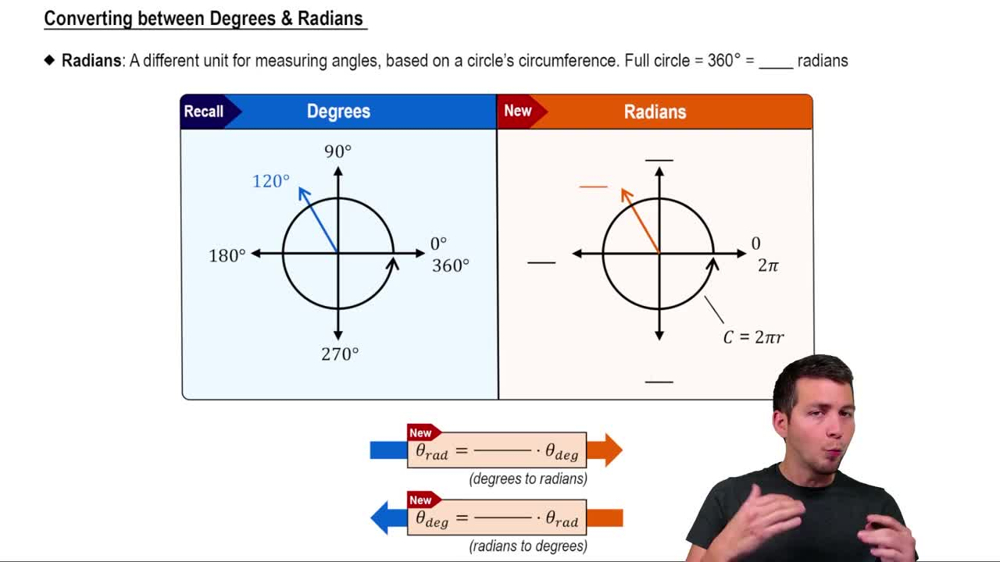
Radians and degrees are two units for measuring angles. Understanding how to convert between them (1 radian = 180/π degrees) is essential for interpreting and expressing solutions correctly. Problems may require answers in both units, rounded appropriately as specified.
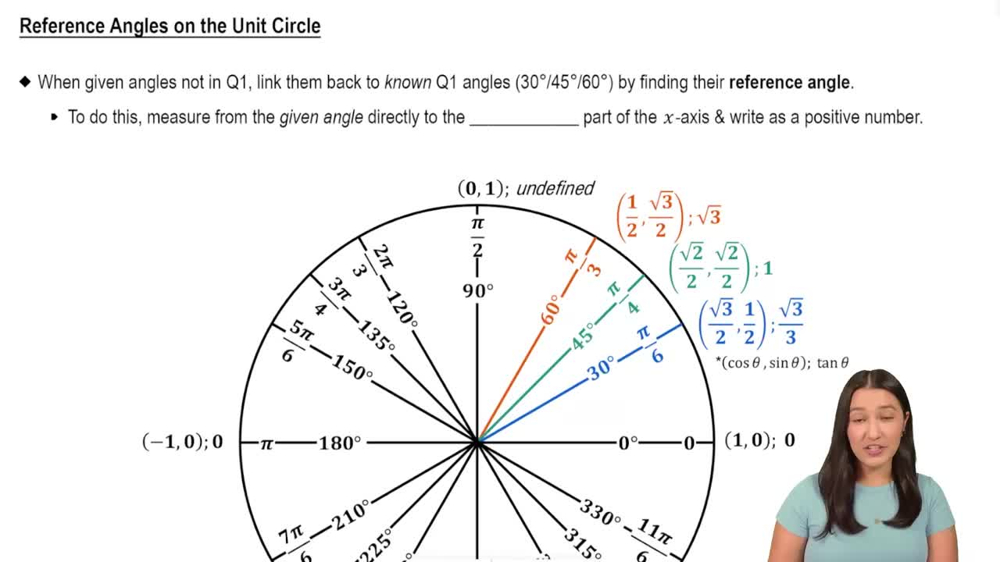
The unit circle helps identify exact values of sine, cosine, and tangent for common angles. Reference angles allow finding all solutions within a cycle by relating angles to their acute counterparts. This is crucial for expressing solutions as least nonnegative angles and for determining all possible solutions.