In Exercises 5–8, each expression is the right side of the formula for cos (α - β) with particular values for α and β. b. Write the expression as the cosine of an angle.cos 50° cos 20° + sin 50° sin 20°
Verified step by step guidance
1
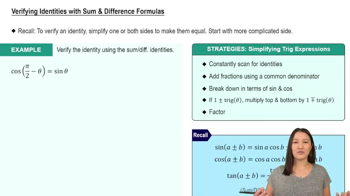
Recognize the trigonometric identity for the cosine of a difference: \( \cos(\alpha - \beta) = \cos \alpha \cos \beta + \sin \alpha \sin \beta \).
Identify the given expression: \( \cos 50^\circ \cos 20^\circ + \sin 50^\circ \sin 20^\circ \).
Compare the given expression with the identity to determine \( \alpha \) and \( \beta \).
Notice that \( \alpha = 50^\circ \) and \( \beta = 20^\circ \).
Write the expression as \( \cos(50^\circ - 20^\circ) \).
Verified video answer for a similar problem:
This video solution was recommended by our tutors as helpful for the problem above
Video duration:
2m
Play a video:
0 Comments
Key Concepts
Here are the essential concepts you must grasp in order to answer the question correctly.
Cosine of Angle Difference Formula
The cosine of the difference of two angles, α and β, is given by the formula cos(α - β) = cos(α)cos(β) + sin(α)sin(β). This formula is fundamental in trigonometry as it allows for the simplification of expressions involving the cosine of angle differences into products of cosines and sines.
Verifying Identities with Sum and Difference Formulas
Trigonometric Values
Trigonometric values such as cos(50°) and sin(20°) represent the ratios of the sides of a right triangle relative to its angles. Understanding these values is essential for evaluating trigonometric expressions and applying them in various contexts, including solving problems involving angles and distances.
In trigonometry, angles can be represented in various forms, including degrees and radians. Converting between these forms is crucial for accurate calculations. In this context, recognizing that the expression cos(50°)cos(20°) + sin(50°)sin(20°) can be rewritten as cos(50° - 20°) demonstrates the application of the cosine difference formula.

 2:00 minutes
 Verified step by step guidance
 2:25
2:25